7 min read
March 5, 2026
5 Ways to Cut Fleet Operating Costs
Lower your fleet operating costs with fuel management best practices. Learn how benchmarking, strategic fuel purchasing, and operational insights can unlock significant savings.
Read more9 min read
March 6, 2026

Share:
Table of contents
Browse the table of contents to jump straight to the part you’re looking for
Shippers are grappling with fluctuating diesel prices, rising consumer demand for sustainable products, and fast-approaching sustainability deadlines. This has fueled the search for reliable alternatives to traditional diesel. The challenge? Finding a fuel that’s readily available along your route, compatible with carriers’ equipment, and cost-effective.
Natural gas offers a compelling solution, providing a practical and effective pathway to greater cost stability and reduced emissions. Available in several forms—including compressed natural gas (CNG), liquefied natural gas (LNG), and renewable natural gas (RNG)—it presents a versatile option compared to diesel. This article will examine the core advantages of natural gas, its practical applications, and key considerations for evaluating natural gas bids in your next RFP to create a more resilient transportation network strategy.
Natural gas is available in diverse forms, including compressed natural gas (CNG), liquefied natural gas (LNG), and renewable natural gas (RNG), each suited for different applications.
Compared to the price volatility of petroleum-based fuels, natural gas offers greater cost stability, leading to more predictable budgeting and for energy.
Natural gas provides significant emissions reduction benefits, with RNG reducing emissions by 75-143% depending on the feedstock source.
While challenges like infrastructure and equipment costs exist, strategic adoption on specific routes can yield substantial cost and sustainability advantages.
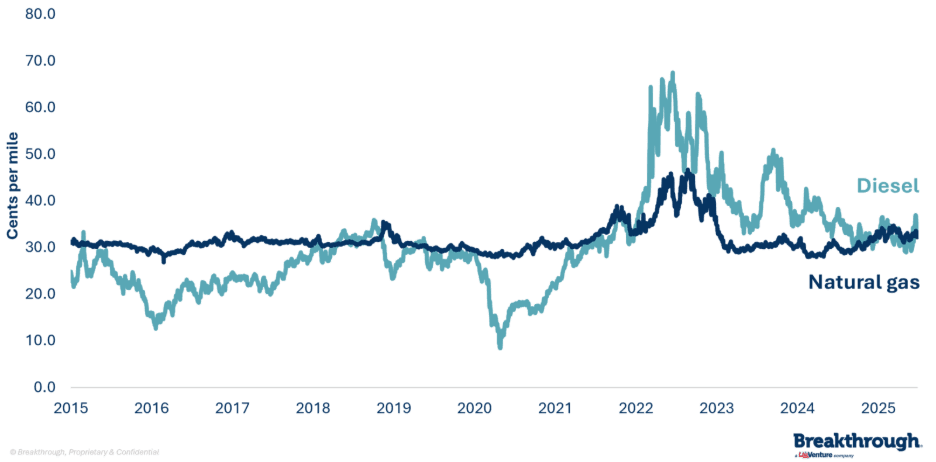
When comparing natural gas to diesel, the key differentiators are cost and emissions. Natural gas prices are generally more stable and often lower than petroleum-based fuels, insulating shippers and carriers from market volatility. For example, since 2013, natural gas prices have remained consistently stable compared to diesel.
From an environmental standpoint, natural gas vehicles have lower lifecycle greenhouse gas (GHG) emissions. This is particularly true for RNG, which is derived from organic waste. For example, on a lane from Illinois to Ohio in July 2025, this translated to a 23% cost reduction and a 44% decrease in absolute emissions for the shipment.
These benefits make natural gas, and particularly RNG, an appealing option for companies aiming to address both economic and environmental challenges. By adopting this energy type, businesses can achieve meaningful cost savings while aligning their operations with sustainability goals in a rapidly evolving market.
Compressed natural gas (CNG), liquefied natural gas (LNG), and renewable natural gas (RNG) each have distinct properties and applications across industries. Understanding the specific benefits and use cases of these fuels is essential for optimizing cost savings, reducing emissions, and achieving sustainability goals.
Compressed natural gas is natural gas stored at high pressure, making it suitable for a wide range of vehicles. It is most commonly used in city buses and light- to medium-duty fleets that operate on regional or return-to-base routes. The benefits of CNG transportation include lower fuel costs compared to diesel and reduced emissions of nitrogen oxides (NOx) and particulate matter (PM).
Liquefied natural gas is created by cooling natural gas to a liquid state, which increases its energy density. This makes LNG an ideal fuel for heavy-duty, long-haul trucking where extended range is critical. While LNG tanks are heavier and require more space than CNG systems, they allow trucks to travel farther between refueling stops.
Renewable natural gas is a biogas produced from renewable feedstocks—such as landfills, farms, and wastewater treatment plants. As a low-carbon fuel, RNG allows carriers to use existing natural gas equipment while achieving near-zero or even negative lifecycle emissions. The use of RNG and CNG is expanding as shippers look for cost-effective ways to meet aggressive sustainability targets.
The transportation industry is at a pivotal juncture, where balancing operational costs with sustainability goals has become more critical than ever. By leveraging RNG, CNG, and LNG, businesses can take a significant step toward achieving their environmental objectives without compromising performance or budgetary constraints.
Natural gas prices historically exhibit less volatility than diesel, which supports greater budget certainty. This stability is a key reason why natural gas is considered a top fuel for transportation. While RNG can have a higher retail price at the pump, partnerships can make it a cost-competitive option.
At retail prices, RNG averages around $0.56 per mile.
With preferred pricing through partnerships or programs like Breakthrough's Fuel Recovery solution, that cost can drop to approximately $0.37 per mile.
Multi-year supply agreements between carriers and fuel providers offer the greatest savings, at approximately $0.32 per mile. Breakthrough’s network of partners can unlock this long-term value.
Natural gas engines produce significantly fewer NOx, PM, and GHG emissions than their diesel counterparts. This not only improves local air quality but also helps shippers achieve emissions reduction goals. In fact, RNG can deliver up to a 143% reduction in emissions depending on the source.
For example, a carrier switching from diesel to RNG on a lane from Bedford Park, Illinois, to West Jefferson, Ohio, achieved:
23% cost savings on the lane
44% reduction in absolute emissions for the shipment
These dual benefits highlight how RNG can deliver both financial and environmental returns.
The infrastructure and supply for natural gas are already well-established in the United States. Taking the same lane from Bedford Park, Illinois, to West Jefferson, Ohio, there are 18 CNG and RNG fueling stations along the route. Leveraging this domestic resource reduces the nation’s reliance on foreign crude oil and enhances energy resilience against geopolitical disruptions, further strengthening supply chain stability.
Although natural gas offers many benefits, it still faces significant adoption challenges.
Fueling Infrastructure Limitations: Although the network is growing, natural gas refueling stations are less common than diesel stations. However, CNG and RNG fueling stations for heavy-duty vehicles are now widely available along major freight corridors.
Vehicle Compatibility and Conversion Costs: Fleets must invest in new natural gas vehicles or retrofit existing ones with specialized engines and storage systems, which requires upfront capital.
Lifecycle Emissions Considerations: While cleaner than diesel, conventional natural gas is still a fossil fuel that produces GHG emissions. RNG dramatically improves this, but its adoption is still in the early stages.
Natural gas is particularly effective for shippers with predictable routes and centralized refueling capabilities. When considering a switch, shippers should conduct a cost-benefit analysis that weighs the upfront investment in vehicles and infrastructure against the long-term savings from lower fuel costs and the sustainability benefits of reduced emissions.
Natural gas serves as an important transitional fuel, bridging the gap between today’s diesel-dependent transportation networks and a zero-emissions future. As a mature and scalable solution, natural gas allows shippers to make immediate progress on decarbonization goals while other technologies like battery-electric and hydrogen vehicles continue to develop. The growing availability of RNG and supportive policy incentives are expanding the role of natural gas in building a sustainable transportation ecosystem.
Natural gas remains a compelling choice among alternative energy options for transportation. Its proven benefits of cost stability, lower emissions, and a secure domestic supply make it a practical solution for many shippers. While adoption challenges must be addressed, the diverse forms of natural gas—CNG, LNG, and especially RNG—provide a clear and actionable path for shippers to reduce costs and emissions today.
CleanMile, Breakthrough's transportation emissions management platform, can help you adopt alternative energy in your network. With a proven track record and strong partnerships, our team is ready to guide you every step of the way. In 2025 alone, we helped increase shipper's alternative energy utilization by an average of 33%. Learn more about CleanMile and how it can move your sustainability strategy forward.
Yes, natural gas is considered an alternative fuel. It is a cleaner-burning option than conventional petroleum-based fuels like diesel. The U.S. Department of Energy officially designates natural gas, in both its compressed (CNG) and liquefied (LNG) forms, as an alternative transportation fuel. It serves as a key component in strategies to diversify energy sources and reduce transportation-related emissions.
Natural gas benefits transportation primarily through cost savings, emissions reductions, and energy security. Its price is typically more stable and lower than diesel, offering greater budget predictability. Natural gas vehicles produce fewer harmful pollutants like nitrogen oxides and particulate matter, and renewable natural gas (RNG) can lower lifecycle carbon emissions to near-zero. As a domestically abundant resource, it also reduces reliance on foreign oil.
CNG (Compressed Natural Gas) is stored in high-pressure tanks and is best for medium-duty vehicles on regional routes. LNG (Liquefied Natural Gas) is chilled to a liquid state, making it denser and better for long-haul, heavy-duty trucks needing a longer range. RNG (Renewable Natural Gas) is chemically identical to conventional natural gas but is derived from organic waste, giving it a much lower carbon footprint.
Compared to diesel, natural gas generally offers lower and more stable fuel costs, protecting fleets from price volatility. From an emissions standpoint, natural gas burns cleaner, producing fewer nitrogen oxides and particulate matter. While conventional natural gas still emits CO2, its lifecycle emissions are lower than those of diesel. Renewable natural gas (RNG) can reduce lifecycle emissions by over 100%, offering a significant advantage over diesel.
CleanMile
Breakthrough can help you navigate the complexities of adopting natural gas and secure exclusive pricing.

7 min read
March 5, 2026
Lower your fleet operating costs with fuel management best practices. Learn how benchmarking, strategic fuel purchasing, and operational insights can unlock significant savings.
Read more
9 min read
March 2, 2026
Escalating Middle East conflict is driving up crude oil and diesel prices. Learn how this geopolitical risk impacts fuel costs and how to manage the volatility.
Read more
5 min read
February 23, 2026
Explore how escalating U.S.–Iran tensions are impacting global energy markets, driving volatility in crude oil and diesel prices, and increasing supply chain risks.
Read more