
20 min read
September 9, 2026
Iran War: Energy Market Impact Tracker
Track the Iran War's impact on energy markets. Use our weekly update to protect your transportation budget. Read the latest today.
Read more7 min read
June 16, 2026

Share:
Table of contents
Browse the table of contents to jump straight to the part you’re looking for
Navigating today's global shipping landscape can feel overwhelming. Shippers are grappling with volatile fuel prices and a complex web of regulations, all intensified by recent geopolitical conflicts. This leaves supply chain leaders searching for clarity and control over their maritime transportation costs and strategies. The solution lies in leveraging data-driven insights to achieve transparency. By understanding the true drivers of cost and performance, shippers can move from a reactive position to a proactive one, securing fair pricing and building resilient supply chain networks.
Recent geopolitical conflict has removed approximately 600 million barrels of energy from the global market. This is equivalent to several months of international shipping fuel. This level of disruption does not just raise prices. It fundamentally alters how fuel markets behave within maritime transportation.
While all fuel types have seen price increases, low-sulfur marine gas oil (LSMGO)—used in Emission Control Areas (ECAs)—has experienced an exceptionally steep premium over crude oil. Data shows that in the past 12 months, LSMGO commanded a 41 percent premium to Brent crude, and the recent crisis has pushed this even higher. For example, on some transpacific trade lanes, the cost of LSMGO approached $1,800 per MT in the last two months.
This volatility translates directly to the cost per container. On a lane from South Asia to North America's East Coast, the fuel cost per FEU jumped from $478 in February to $946 in a recent one-month period. Our forecasts suggest these elevated prices will persist for the next three to six months, as it will take time for the market to rebalance from months of disruption.
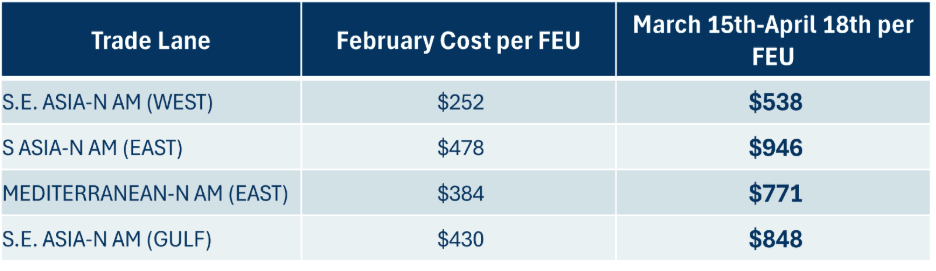
This price volatility has intensified an existing challenge for shippers: a lack of transparency in fuel surcharges. Bunker adjustment factors vary considerably by carrier, making it difficult for shippers to validate the costs passed to them. This has led to a breakdown in trust, with many shippers questioning if they are paying for inefficiencies or costs from other trade lanes.
A fair and accurate fuel reimbursement process should be built on a foundation of transparent data. This involves:
By adopting a data-driven approach, shippers can move beyond unclear surcharges and ensure they are paying a fair price for the fuel consumed in their specific movements.
The effects of geopolitical conflict extend beyond fuel prices into network reliability and regulatory complexity.
The rerouting of vessels around the Cape of Good Hope to avoid conflict zones adds up to 12 days to a trade lane. To maintain service levels, carriers must deploy more vessels, which tightens global capacity. This has a bullwhip effect across the supply chain, where initial delays compound at major transshipment hubs in Asia and cause congestion in European ports.
Schedule reliability has suffered as a result. With 30% of all port calls arriving late, shippers face significant uncertainty. Carriers are responding by restructuring networks and discontinuing services, adding another layer of complexity for procurement teams to track.
Following the easing of drought-related transit restrictions, the Panama Canal has seen a strong rebound in vessel traffic over the past year. Transit volumes have exceeded pre-drought levels, driven by global rerouting dynamics. Ongoing disruptions in the Red Sea have pushed carriers to shift trade flows back toward the canal, reinforcing its role as a critical route for global shipping. This resurgence is helping restore some network efficiency, but also highlights how quickly geopolitical and environmental changes can reshape maritime routing patterns.
Environmental regulations continue to add cost and complexity to maritime transportation. The EU Emissions Trading System (ETS) is being phased in, with 100% emissions for trade lanes within the EU covered by 2026. This cost carriers an estimated $1.5 billion in 2025 and is projected to rise to $2.7 billion. Carriers pass this cost to shippers through various surcharges, which are often bundled into freight rates or BAFs, obscuring the true cost.
Additionally, new ECAs are emerging. The North-East Atlantic Ocean ECA, set to be the world’s largest, will likely come into effect in 2027 or 2028. This will connect existing ECAs and further increase the demand for more expensive low-sulfur fuels, accentuating the need for accurate emissions tracking and cost management.
Volatility across maritime transportation is unlikely to subside in the near term. Geopolitical uncertainty, evolving regulations, and shifting global trade patterns will continue to introduce variability into both cost and service. The difference between reactive and resilient organizations will come down to visibility.
Shippers that understand their fuel costs, validate their pricing, and align procurement strategies to real market conditions will be better positioned to control spend, strengthen carrier relationships, and maintain reliable service.
Breakthrough’s Marine Fuel Recovery enables this shift by grounding fuel reimbursement in real consumption, geography, and pricing—helping organizations move from uncertainty to control across their maritime transportation networks.
Geopolitical events, such as conflicts in major oil-producing regions like the Middle East, disrupt the global supply of crude oil and refined products. This reduction in supply creates a market shock, causing a rapid increase in the price of bunker fuels used in maritime transportation. Low-sulfur fuels are often hit hardest due to their demand in other transportation sectors and refining dynamics, leading to significant cost increases per container.
BAFs vary because carriers use different methodologies to calculate them. These formulas may include different trade factors, fuel consumption estimates, and vessel utilization assumptions. Some carriers also bundle other costs, like ETS charges, into their BAFs. This lack of a standardized, transparent approach results in wide cost variations for shippers, even on the same trade lane.
The EU Emissions Trading System (ETS) is a "cap and trade" system designed to reduce greenhouse gas emissions. For maritime, it requires carriers to purchase and surrender carbon allowances for a portion of the emissions from voyages connected to the EU. This cost is passed on to shippers as a surcharge. The percentage of emissions covered is increasing to 100% in 2026, which will continue to add to the total cost of shipping in the region.
Rerouting vessels from the Suez Canal to the longer journey around Africa's Cape of Good Hope can add 10 to 12 days to a voyage. To maintain a weekly service schedule on a trade lane, carriers must deploy additional vessels. This effectively absorbs shipping capacity from the global fleet, tightening the market and putting upward pressure on freight rates.
Marine Fuel Recovery
Replace estimates with market-based fuel pricing and bring visibility to every shipment in your network.
20 min read
September 9, 2026
Track the Iran War's impact on energy markets. Use our weekly update to protect your transportation budget. Read the latest today.
Read more
3 min read
August 12, 2026
Visit Breakthrough at booth 302 during CSCMP EDGE and hear Andersen Corporation share how data-driven insights help manage fuel volatility and rising costs.
Read more
7 min read
August 7, 2026
Learn how marine fuel procurement affects bunker fuel costs, BAFs, and ocean transportation spend, and discover how greater transparency can improve cost management.
Read more