5 min read
2025 Transportation Decarbonization Report
March 1, 2025
Share:
Table of contents
Browse the table of contents to jump straight to the part you’re looking for
Executive Summary
The 2025 Transportation Decarbonization Report sheds light on the significant role transportation can play in U.S. CO2 emissions, contributing to around 30%. Among Breakthrough's industry-leading shippers with SBTi commitments, a robust 96% have set scope 3 targets and 64% of these have explicit transport-specific goals.
By reading the report, shippers can incorporate policies and emission reduction strategies into their 3 to 5-year business plan, keeping aligned with the emerging shift toward a low-carbon economy. Significant trends include the shift toward alternative energy in transportation and the need for actionable strategies to cut emissions.
Key Takeaways
- Inclusion of emission reduction plans in long-term business strategies is crucial to avoid being left behind in the sustainability race.
Upcoming policies like the EPA’s Phase 3 Heavy-Duty Vehicle (HDV) Emissions Standards and Clean Fuel Standards will shape future regulatory requirements and open new opportunities. - The rising interest in alternative energy, like Renewable Natural Gas (RNG) and Electric Vehicles (EVs), shows promise in reducing transportation emissions.
- Achieving sustainability goals requires a mix of carrier selection, route optimization, mode conversion, and alternative energy adoption.
Explore the 2026 Decarbonization Report
Check out the 2026 Decarbonization Report for the most up-to-date trends and insights.
Key Policies and Legislation to Watch in 2025
Policy and regulatory shifts will bring both new challenges and opportunities for advancing a low-carbon future. For transportation, energy, and manufacturing stakeholders, this is a pivotal time to stay proactive, adaptable, and focused on long-term sustainability goals. Those who navigate these changes efficiently and effectively won’t only meet regulatory requirements but will also position themselves as leaders in a more resilient, low-carbon economy.
Federal
Under President Trump’s leadership, the regulatory landscape is anticipated to shift toward widespread deregulation, placing more responsibility on state and local governments to advance sustainability initiatives. While this decentralized approach may hinder federal climate efforts and result in uneven progress across the country, it also opens the door for companies to step up and lead sustainability efforts in their regions.
Looking ahead to President Trump's second term, several predictions have emerged regarding the direction of environmental policies. During his previous term, the U.S. withdrew from the 2015 Paris Climate Agreement, aligning with a small group of nations, including Iran, Libya, and Yemen, that did not sign the landmark accord. On his first day back in office, he signed an executive order expressing his intent to withdraw from the Paris Climate Agreement again. Although the formal withdrawal process takes a year between notification and exit, this sends a strong signal to the world.
Additionally, Trump’s campaign has promised to repeal many of Biden’s climate policies, including the Inflation Reduction Act. However, the act’s funding has already made notable progress in local communities, which may make dismantling these programs politically challenging for the new administration and Congress.
Key policies to watch this year include the EPA’s Phase 3 Heavy-Duty Vehicle (HDV) Emissions Standards, evolving regulations around fossil fuel production, and the potential reintroduction of the Rail Safety Bill. Together, these developments will shape the next chapter of U.S. climate policy, with implications for both government and private sector leadership.
EPA’s Phase 3 HDV Emissions Standards |  | The EPA’s Phase 3 HDV Emissions Standards are expected to drive significant emissions reductions for heavy-duty trucks, acting as a catalyst for the transportation sector to adopt cleaner, more efficient fleets. Companies will need to prioritize investments in more efficient vehicles and alternative energy to meet these stricter standards. Although it is expected that Congress and the Trump administration will create a new or modified regulation that aligns more with the status quo. | |
Deregulating Fossil Fuel Production | | President Trump’s push for deregulating fossil fuel production, including expanded leasing of federal lands, presents a mixed outlook for the energy sector. Although deregulation may lower costs, sluggish demand and poor pricing signals may not lead to the anticipated rush in production. | |
Rail Safety Bill | | The Rail Safety Bill, which may resurface in the 119th Congress, aims to improve safety standards for freight rail, particularly in the transportation of hazardous materials. The legislation could reshape how hydrogen and RNG are transported, which could have significant supply chain implications. |
State
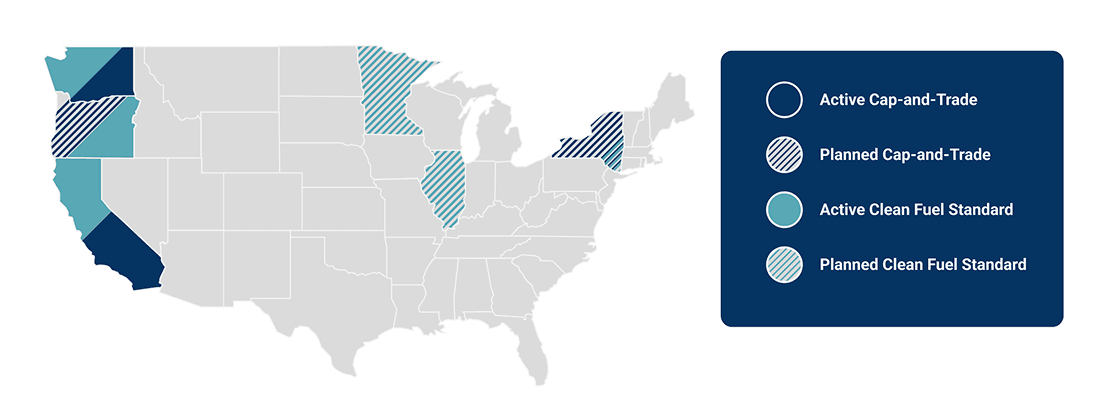
Clean Fuel Standards
Clean fuel standards set limits on the emissions intensity of fuel supplies produced in or supplied to the state. Clean fuel standards create additional costs for traditional fuels while also creating a new market for alternative fuels.
Cap-and-Trade
Cap-and-trade programs set a limit, or a cap, on the amount of CO₂ that can be emitted for a given year from either the entire economy, key sectors, or covered entities emitting above a certain threshold. Each year, the cap declines, incentivizing organizations to either reduce emissions or purchase allowances.
International
Corporate Sustainability Reporting Directive (CSRD)
The EU’s Corporate Sustainability Reporting Directive (CSRD) has extended its compliance deadline for non-EU companies to 2026. This regulation will apply to a broader set of large companies, as well as listed small and medium-sized enterprises (SMEs). Additionally, non-EU companies generating over EUR 150 million in the EU market will also need to comply. This extension allows key industries such as oil, gas, transport, and energy to align their operations with the new sustainability reporting standards, ensuring they are positioned to meet these requirements.
Marine
EU Emissions Trading System
The EU Emissions Trading System (ETS) expanded its efforts to include shipping emissions starting in 2024. Initially covering 40% of emissions from large cargo vessels, this scope will expand to 70% in 2025.
FuelEU
The FuelEU, which comes into effect in 2025, mandates ships calling at EU ports to reduce the greenhouse gas intensity of their fuels. Additionally, ships operating in the Mediterranean SOx Emission Control Area (ECA) will face stricter sulfur content limits starting in May 2025, underscoring the region’s commitment to curbing air pollution from maritime transport.
Drive Strategic Decisions in a Complex Regulatory Landscape
The evolving regulatory environment in the transportation industry highlights the pressing need for sustainable fuel and freight solutions and forward-thinking strategies. For global shippers, the urgency to decarbonize must stay at the forefront. Even as federal mandates or support fluctuate, the drive to reduce emissions remains unwavering. This momentum is fueled by mounting pressure from shareholders, discerning consumers, and forward-thinking competitors, underscoring the undeniable need for sustainable practices. Acting sustainably isn’t just a responsibility—it’s a competitive imperative to reduce your carbon footprint and foster operational efficiency.
A Dive into the Alternative Energy Landscape
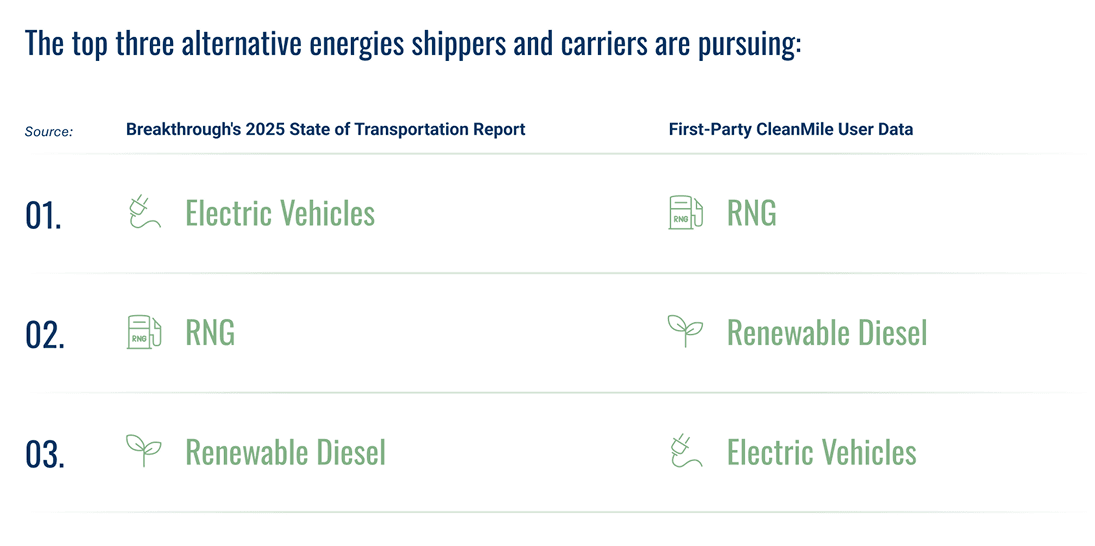
As policies and legislation increasingly push shippers to reduce emissions, the transportation industry is turning to alternative energy as one way to meet these demands. A closer examination of renewable natural gas (RNG), electric vehicles (EVs), biofuels, and hydrogen highlights the factors influencing their adoption.
Renewable Natural Gas (RNG)
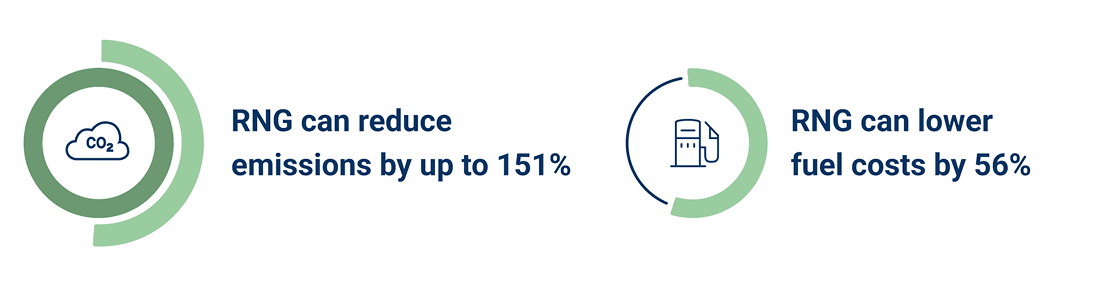
RNG has emerged as one of the leading alternatives to diesel, providing greater cost stability and a lower environmental impact. Depending on the feedstock, RNG can reduce emissions by up to 151%, and RNG can lower fuel costs by 56%.
RNG is derived from organic waste, and its use significantly cuts carbon emissions, making it a powerful fuel type for transportation leaders looking to decarbonize their fleet.
One of the standout advantages of RNG is its compatibility with existing infrastructure, nearly every CNG station can be used to dispense RNG. This is especially important given that there are over 770 public CNG stations in the U.S. that are accessible to Class 8 trucks. Although CNG equipment comes at an on-cost, it is significantly lower than that of electric vehicles. This added expense may influence decisions, but it can be balanced by long-term fuel savings.
Electric Vehicles (EVs)
Electric vehicles have also become a crucial part of the alternative energy landscape, offering 60% emissions reduction and 52% lower fuel costs than diesel. While the upfront vehicle cost is more expensive than a diesel truck, overall maintenance costs are on average 40 to 70% lower. One primary concern of adopters is the number and location of EV charging infrastructure. EV charging infrastructure is still being developed along major interstates, initiatives are planned to alleviate these concerns.
A third of carriers (34%) say they plan to add battery electric vehicles (EVs) to their fleets in 2025 (Source: Breakthrough's 2025 State of Transportation Report). A significant initiative to address this gap is the $248.9 million grant awarded by the EPA to the Clean Corridor Coalition, aimed at establishing a network of electric truck charging stations along the I-95 corridor. This project will create 24 charging sites with 450 ports, helping to reduce 18.6 million metric tons of GHG emissions by 2050.
Hydrogen
Hydrogen's high energy density and fast refueling times make it an appealing option, particularly for applications requiring heavy payloads and long ranges. While the upfront cost – approximately 125% more than diesel trucks without incentives – remains a barrier to broader adoption, its potential to provide zero-emission, long-distance capabilities position hydrogen as a valuable energy option.
Biofuels
Biofuels, such as biodiesel and renewable diesel, are gaining recognition as viable and cost-competitive conventional diesel alternatives, offering significant environmental advantages. With over 1,984 fueling locations available across the U.S., biofuel infrastructure continues to expand, reinforcing its accessibility for transportation fleets. Lifecycle GHG emissions reductions vary based on the production method and feedstock used. The adoption of renewable diesel delivers up to a 76% decrease compared to conventional diesel. Additionally, their compatibility with existing diesel engines can ensure a seamless transition for fleets seeking to incorporate low-carbon fuels.
The Power of a Polyfuel Strategy
A polyfuel strategy enables shippers to align environmental objectives with operational demands by assessing the optimal use case for each fuel type. With a third of shippers saying limited access to alternative energy in their service area or along their routes has been a limiting factor, according to Breakthrough’s 2025 State of Transportation Report, shippers need to carefully consider their fuel options. To effectively minimize their carbon footprint, shippers must look beyond fuel selection and leverage additional, data-driven strategies for reducing emissions.
Actionable Strategies for Shippers to Cut Transportation Emissions
With policy and regulatory shifts requiring shippers to report and reduce emissions, along with advancements in alternative energy supply and infrastructure, it’s more important than ever for shippers to implement effective strategies to cut transportation emissions. In fact, 87% of shippers have set long-term sustainability-related transportation goals for 2025, according to Breakthrough’s 2025 State of Transportation Report.
By focusing on a combination of tactics, such as carrier selection, route optimization, mode conversion, and alternative energy adoption, shippers can reduce cost, improve operational efficiency, and achieve their sustainability goals.
However, knowing where to begin can be challenging, and even after starting, executing initiatives effectively can feel overwhelming.
Carrier Partnerships
Discussing sustainability plans with carriers gives shippers valuable insights for fostering strong, long-term partnerships. By promoting strategies that enhance SmartWay scores—like fuel-saving practices and investing in alternative energy equipment—shippers can achieve up to a 14% reduction in emissions per load.
Alternative Energy
By collaborating with carriers to understand their long-term fleet goals and willingness to invest in alternative energy equipment, shippers can take meaningful steps toward cutting transportation emissions. One effective way to gather this information is by using RFIs or RFPs to collaborate with carriers focused on adopting alternative energy-powered vehicles – an approach only 14% of shippers have adopted, according to the 2025 State of Transportation Report. This approach also allows for a precise calculation of your total emissions.
Mode Conversion
Mode conversion is essential for reducing transportation emissions, as it enhances freight efficiency by transitioning shipments to more sustainable modes. For example, moving long-haul truck shipments to rail can improve fuel efficiency by up to 70% per load.
Route Optimization
Route optimization is essential for reducing empty miles and maximizing load fill, helping shippers and carriers lower fuel consumption. Additionally, recent mergers and acquisitions present valuable opportunities to refine routing guides. Unused capacity contributes to 12% of emissions, which equates to 96.3 kgCO2e of transportation emissions monthly. Load fill optimization could yield nearly $1 billion in fuel & freight savings annually.
Elevate your strategy with a transportation emissions management platformTransportation emissions management platforms, such as CleanMile, are transforming the way shippers approach carbon reduction by delivering lane-level tracking and reporting for both truckload and rail operations. These data-focused tools go beyond simple reporting, offering actionable insights that enhance efficiency while reducing emissions. CleanMile clients are seeing an average of 6% reduction in emissions intensity in their first full year on our program. | 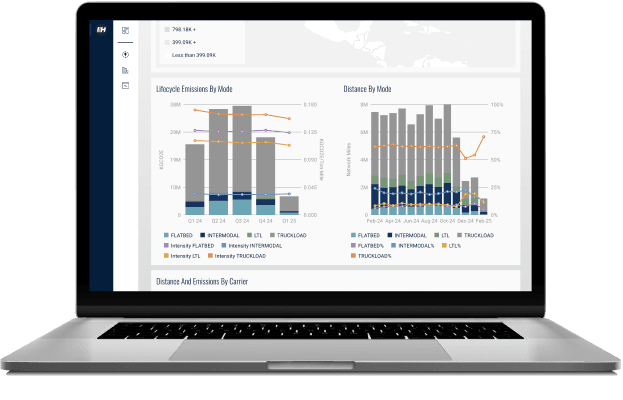 |
Ready to lead the charge in decarbonization?
Learn how Breakthrough’s CleanMile solutions can help you reduce emissions, improve sustainability, and achieve your decarbonization goals.

Download the report
Take the full 2025 Decarbonization Report with you. Download your copy to save these insights for future reference or to share them with your team.