21 min read
October 28, 2026
Iran War: Energy Market Impact Tracker
Track the Iran War's impact on energy markets. Use our weekly update to protect your transportation budget. Read the latest today.
Read more7 min read
November 2, 2026

Share:
Table of contents
Browse the table of contents to jump straight to the part you’re looking for
Transportation sustainability has become a strategic business priority for shippers. However, as organizations work to reduce emissions and meet evolving sustainability commitments, many face the same challenge: they cannot accurately measure the impact. Without reliable transportation emissions data, decarbonization strategies are built on estimates instead of actuals, and that gap makes it difficult to prove progress, prioritize the right initiatives, or respond to regulatory and customer pressure.
Emissions visibility changes that equation. It gives transportation and supply chain leaders a load-level view of emissions across their network, helping them make more informed decisions about mode selection, carrier strategy, and network design, so decarbonization efforts are grounded in fact rather than assumption.
Emissions visibility refers to a shipper's ability to see, measure, and understand the greenhouse gas emissions generated by its transportation network at a granular level, down to individual shipments, lanes, and modes. Rather than relying on industry averages or high-level estimates, this shipment-level emissions analysis calculates a precise carbon footprint across a company's transportation activity.
For most shippers, transportation touches every part of the supply chain, from inbound raw materials to outbound finished goods. That means Scope 3 emissions, largely captured under Category 4 and Category 9, represent a significant share of a company's total carbon footprint. Without accurate carbon performance data, sustainability strategies are missing one of their largest levers.
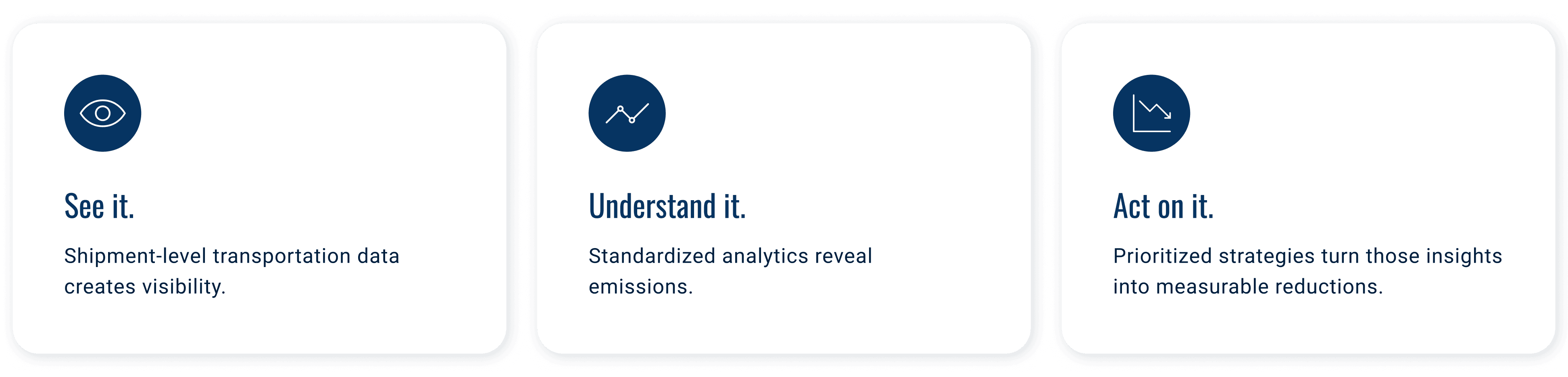
Transportation networks are complex, with freight moving across multiple modes, regions, and carrier partners. That complexity makes emissions data difficult to consolidate and even harder to trust. Consistent emissions measurement solves this by aggregating shipment-level data across the network into a single, accurate baseline.
With that baseline in place, transportation leaders can identify which lanes, modes, or carriers have the greatest impact on emissions intensity, and where opportunities for improvement exist. This level of detail supports more strategic network design, helps prioritize decarbonization investments, and creates a defensible data set for internal and external reporting.
Emissions performance is no longer a separate conversation from business performance. A more efficient transportation network can deliver both cost savings and emissions reduction. Reducing miles traveled, improving asset utilization, and selecting more efficient modes can help shippers advance both priorities.
Without accurate emissions data, organizations may struggle to assess progress, prioritize improvement initiatives, or respond to evolving reporting requirements. Companies with strong transportation emissions insights can evaluate cost, service, and carbon performance together, enabling more strategic and informed decision-making across the network.
Accurate, load-level emissions data gives transportation leaders the confidence to make network decisions, from carrier selection to mode shifts, based on real performance rather than approximation. This reduces conjecture and helps teams prioritize the initiatives that will have the greatest impact.
Reliable emissions measurement is the foundation for any decarbonization plan. It establishes the baseline needed to set realistic targets, track progress against them, and identify the highest-impact opportunities for reducing transportation emissions, such as converting freight to intermodal, optimizing network design, improving asset utilization, or adopting alternative energy solutions.
As emissions reporting requirements continue to evolve globally, shippers need data they can stand behind. Precise emissions data strengthens sustainability disclosures and helps companies stay ahead of shifting regulatory expectations.
Collecting emissions data can reveal where transportation networks are inefficient, such as underutilized assets, less efficient modes, or lanes with higher fuel consumption. Those same opportunities that lower emissions can also reduce costs, helping shippers improve sustainability performance while strengthening overall transportation efficiency.
A complete picture requires data from every mode in the network, truckload, intermodal, rail, and beyond, so the resulting emissions data reflects the full scope of transportation activity rather than a partial view.
Inconsistent measurement methods make it difficult to compare performance across lanes, business divisions, or time periods. Standardizing how emissions are calculated ensures results are accurate and comparable across divisions, helping organizations report consistently while identifying the opportunities that could drive the greatest impact.
Data on its own is not the end goal. Value comes from translating emissions insights into specific, prioritized actions, whether that's adjusting a lane carrier mix, exploring alternative fuels, or redesigning a portion of the transportation network.
Accurate emissions measurement depends on clean, consistent data flowing in from across the network. Building repeatable processes for collecting shipment-level data reduces gaps and strengthens the reliability of the resulting insights.
Carriers and supply chain partners play a direct role in emissions performance. Working collaboratively with partners, rather than treating emissions reduction as a one-sided mandate, will lead to better data sharing and more sustainable outcomes.
Strong emissions data is not a one-time project. Networks change, carriers change, and market conditions shift. Ongoing monitoring ensures that emissions strategies stay up to date and continue to reflect the current realities of the network.
Advanced analytics can consolidate shipment-level data across modes, carriers, and regions to reveal emissions of hotspots that may otherwise go unnoticed. This allows transportation leaders to prioritize initiatives based on measurable impacts rather than assumptions.
Real-time data allows shippers to move beyond static, backward-looking reports and toward forward-looking forecasts, helping teams anticipate the emissions impact of network changes before they happen.
Technology-enabled emissions tracking makes it possible to measure performance against specific targets over time, giving sustainability and transportation teams a shared, ongoing view of progress.
Customers and regulators alike are asking more detailed questions about supply chain emissions. Companies that have already invested in emissions measurement are better positioned to answer those questions quickly and credibly.
Emissions data does more than support reporting. It provides the insight needed to build supply chain sustainability into the core of network strategy, creating transportation networks that are more efficient, more resilient, and better aligned with long-term business goals.
As sustainability expectations continue to evolve, emissions visibility is becoming a foundational component of transportation strategy. Organizations that can accurately measure emissions across their network are better positioned to identify opportunities for emissions reductions, including those that reduce cost, demonstrate progress, and build more resilient supply chains.
Breakthrough's CleanMile solution gives shippers that precise, actionable view of Scope 1 and 3 transportation emissions, turning data into a clear roadmap for reducing their carbon footprint. Learn more about CleanMile.
What Is Emissions Visibility?
Emissions visibility is the ability to see and measure greenhouse gas emissions generated by a company's transportation network at a detailed, shipment-level scale, rather than relying on broad industry estimates.
Why Is Emissions Visibility Important in Supply Chain Management?
Without emissions visibility, sustainability strategies are built on incomplete information. Visibility gives supply chain leaders the data they need to set realistic goals, track progress, and prioritize the initiatives that will have the greatest impact.
How Do Companies Measure Transportation Emissions?
Companies measure transportation emissions by collecting movement-level shipment data across modes and applying standardized calculation methodologies, which allows for consistent, comparable results across the network.
How Does Emissions Visibility Support Sustainability Goals?
Emissions visibility establishes the baseline needed to set sustainability targets, monitor progress against them, and identify the highest-impact opportunities for reducing transportation emissions across the network.
CleanMile
Gain a clearer view of your transportation emissions with CleanMile.

21 min read
October 28, 2026
Track the Iran War's impact on energy markets. Use our weekly update to protect your transportation budget. Read the latest today.
Read more
7 min read
October 23, 2026
Discover six best practices for implementing Mexico Fuel Recovery, from clean data and TMS integration to carrier communication.
Read more
12 min read
October 6, 2026
The October 5 executive order defers federal tax on dyed diesel used on-highway through December 31, 2026. Learn what it changes, what it does not, and how it affects fleet fuel programs.
Read more