
9 min read
March 6, 2026
Why Natural Gas Is a Top Alternative Fuel in Transportation
Learn why natural gas, including CNG, LNG, and RNG, is a leading alternative to diesel and offers benefits like cost stability and lower emissions.
Read more11 min read
March 9, 2026

Share:
Table of contents
Browse the table of contents to jump straight to the part you’re looking for
The escalating Iran War has triggered extreme volatility across global energy markets, sending crude oil and diesel prices to their highest levels in years. Following the escalation of the U.S.–Israel war with Iran, crude oil prices opened higher Monday with the April 2026 WTI contract touching $119.48 per barrel intra-day, and $81.19 after hours as of 3PM CDT publishing, marking a 32% increase from last week’s close and a 78% increase from February’s end of month, when prices closed the month at $67 per barrel prior to the conflict. Following the close of the market and into this morning, prices have since stabilized where we are trending closer to $85-90 per barrel.
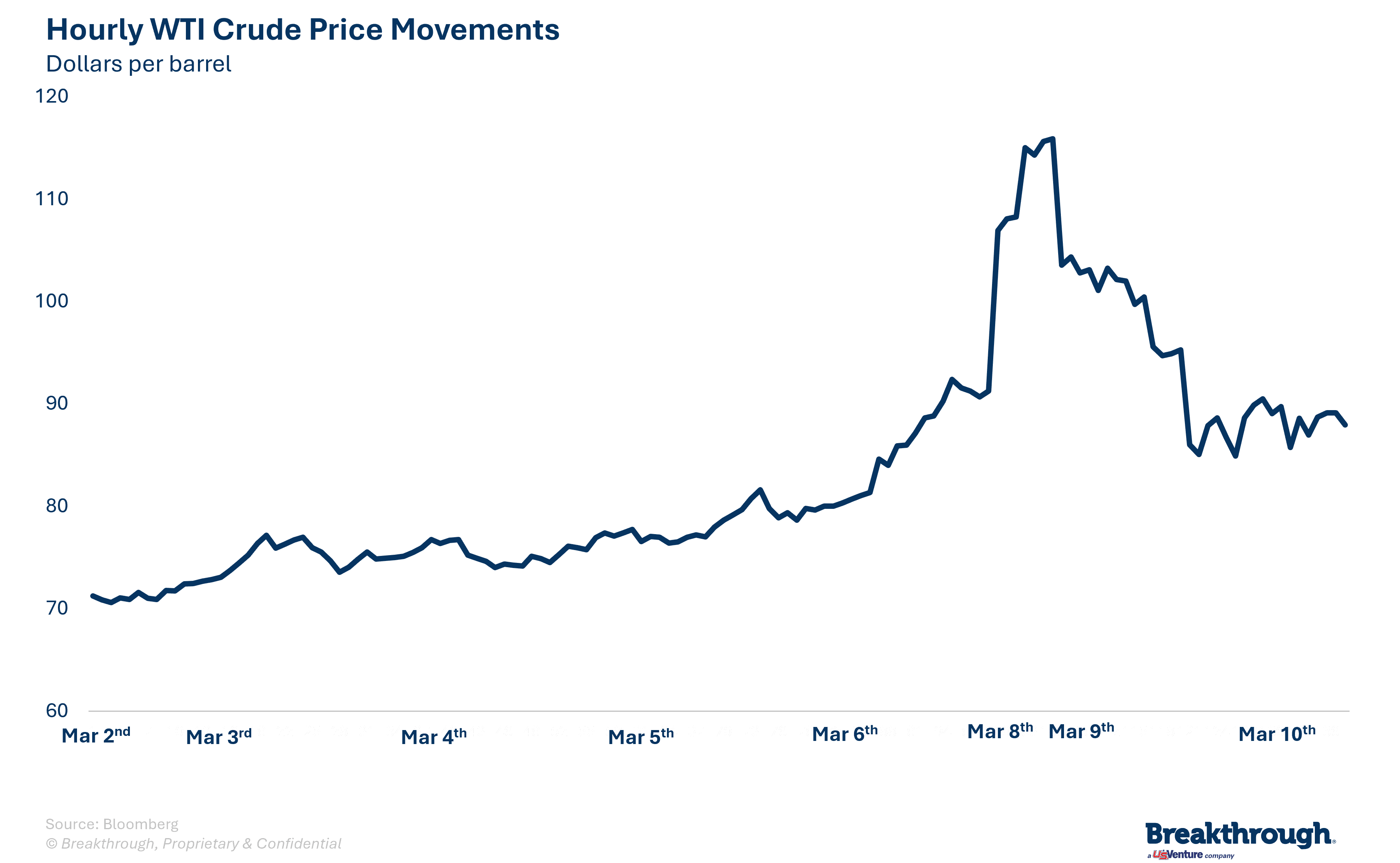
While prices have since pulled back on the April 2026 WTI contract to trade closer to $89 per barrel as of March 10th at 9am CDT, market rhetoric from all sides points to significant uncertainty around how and when the conflict will end. The persistence of elevated volatility reflects an uncertain market. It indicates a market that is quickly reacting to a dynamically changing landscape.
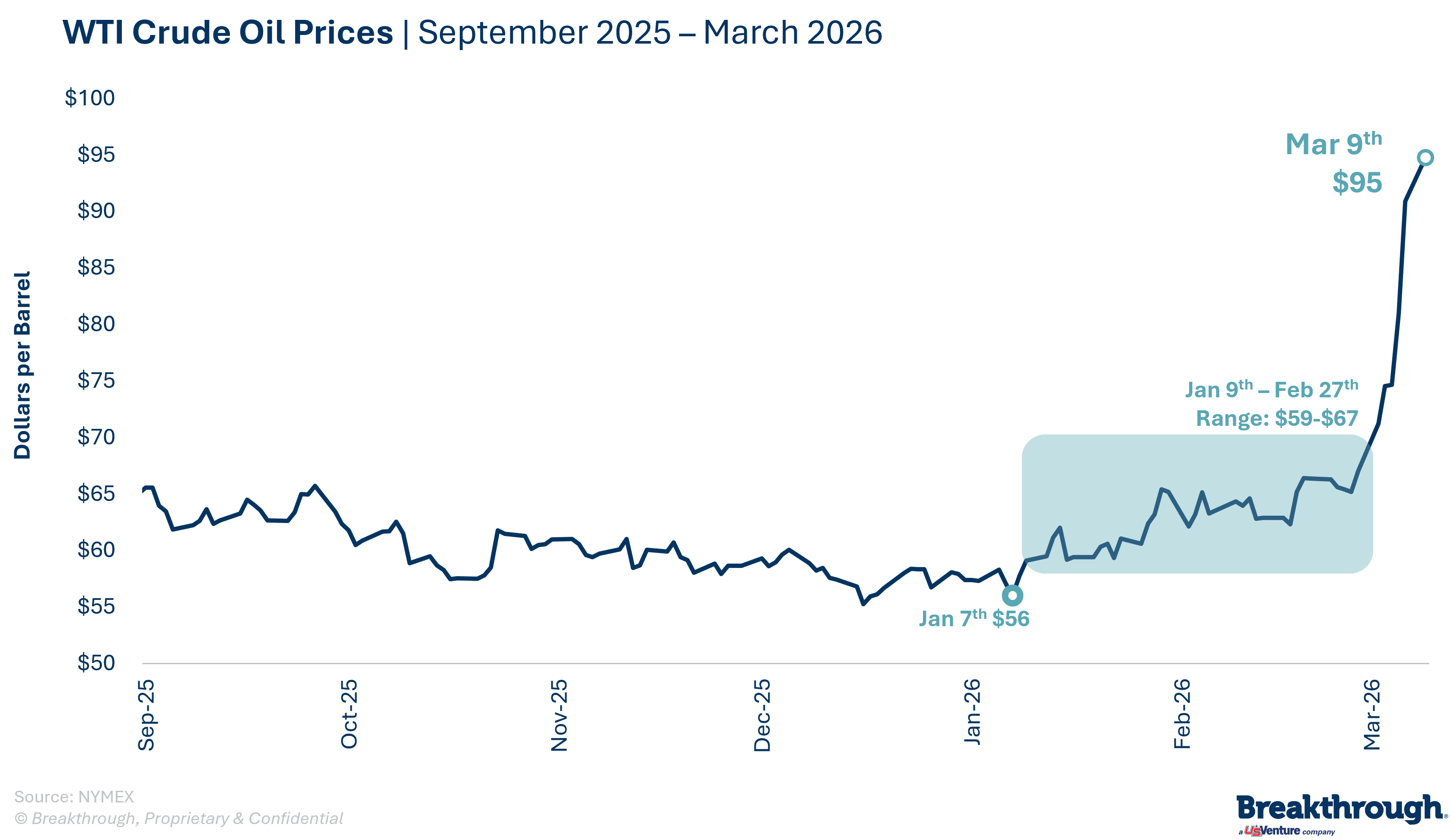
For shippers, this volatility creates immense budget uncertainty and threatens margin planning, making it difficult to forecast transportation costs accurately. To manage this volatile environment, supply chain leaders must understand the direct impacts on fuel and freight and adopt strategies that provide accuracy and cost control.
Since the Iran War began, we’ve seen a significant "war premium" to energy prices, with front month WTI crude oil prices nearing $120 per barrel, softening to $81.19 after hours on March 9.
Disruptions to the Strait of Hormuz, a critical chokepoint for approximately 21% of the world's daily oil supply, are a primary driver of market panic and price surges.
Diesel and other low-sulfur fuels are experiencing acute price volatility due to their essential role in military and commercial logistics, placing additional pressure on transportation budgets.
Shippers should prepare for sustained volatile fuel costs and move toward fuel management strategies that protect their transportation budgets from ongoing market disruptions.
The war between the U.S., Israel, and Iran marks a severe escalation in Middle Eastern tensions, fundamentally repricing geopolitical risk in global energy markets. Unlike previous short-lived shocks, this conflict has directly impacted the physical energy system:
Infrastructure Attacks: Key energy infrastructure across the Persian Gulf has been targeted, leading to damage and shutdowns.
Strait of Hormuz Closure: Iran has closed the Strait of Hormuz, a critical chokepoint for roughly 20% of global crude oil and 4 million barrels per day of refined products.
Production Halt: With tanker traffic stopped, regional storage is filling rapidly. This has forced some producers to cut back or completely shut down production because they cannot get their product to market. Bringing these operations back online is a complex process that can take several weeks, compounding the disruption to global supply.
Kharg Island Threat: The market is also concerned about Kharg Island, which handles a significant portion of Iran's crude exports. The potential for seizure or disruption adds another major risk to global supply.
These factors have embedded a persistent geopolitical risk premium into crude prices. Even if prices pull back from their initial highs, the fundamental supply risk remains unresolved, keeping the market elevated and volatile.
Although crude oil is the largest component of diesel fuel costs, diesel is its own commodity with unique market dynamics.
In the chart below, the blue line shows the diesel commodity price, which includes both the cost of crude oil and the refinery margin. The refinery margin reflects the cost of converting crude oil into ultralow sulfur diesel and is driven by diesel-specific supply and demand dynamics.
Historically:
The refinery margin made up 20–25% of the diesel cost buildup. In 2025, it averaged closer to 27%.
Crude oil typically accounted for 50% of diesel’s total cost, averaging just under that level last year.
This week:
Refinery margins have surged to roughly 40% of the diesel cost buildup.
Crude oil now accounts for approximately 44%.
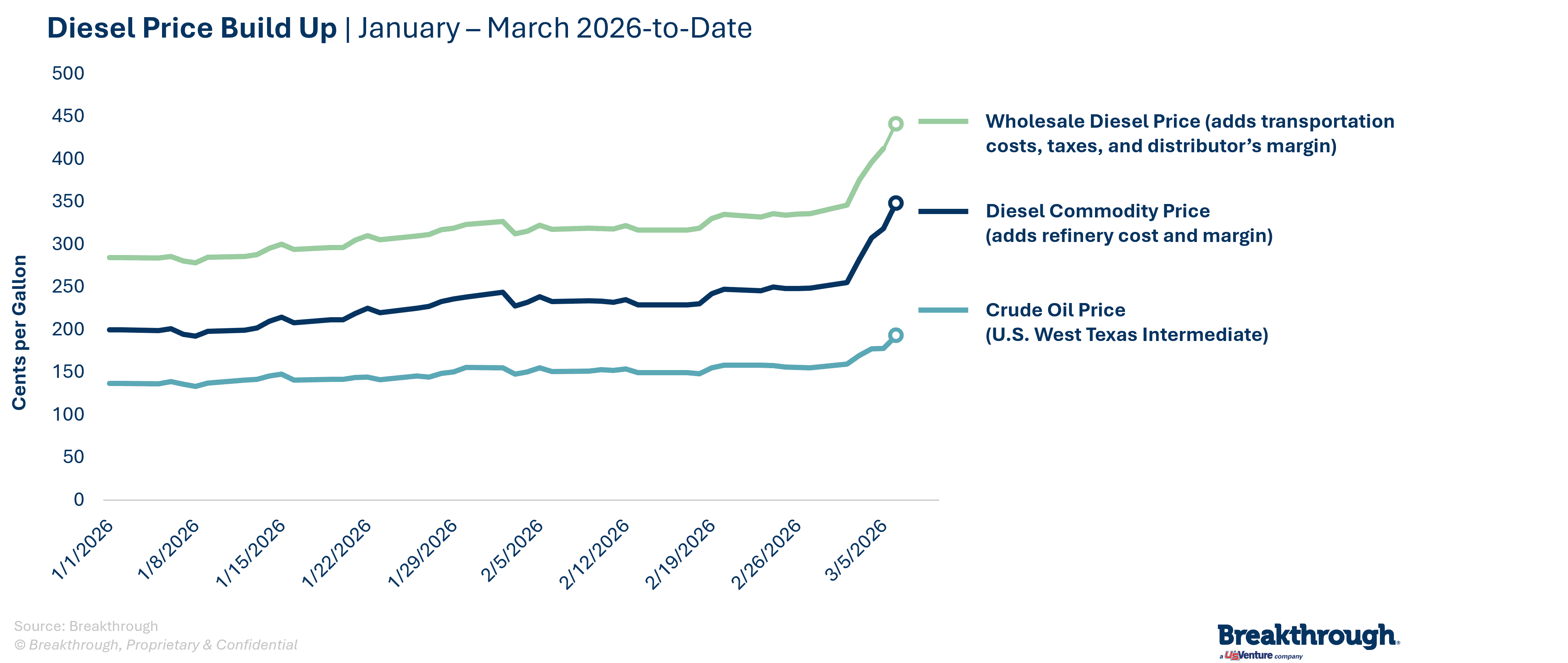
This shift highlights an important reality for shippers: diesel prices are not rising solely because crude prices have been elevated. Diesel-specific constraints are playing an outsized role.
Diesel is highly sensitive to shifts in supply and demand with even modest demand increases or geopolitical shocks triggering outsized price swings, which is what we are experiencing today. Several factors are tightening the global diesel supply:
Declining refining capacity: Conventional refineries are closing or switching to renewable fuel production.
Increased reliance on trade: Europe and other regions are now depending more on global — particularly U.S. origin — diesel imports due to refinery closures and sanctions on previous suppliers to meet demand.
Low inventories: Global diesel stockpiles are low, leaving little buffer for seasonal demand spikes or supply disruptions.
As the situation evolves, several factors will determine the future of energy prices. The key takeaway for transportation and logistics operations is that diesel cost pressure is being driven by both crude oil prices and diesel-specific fundamentals. Even if crude prices stabilize, tight refining capacity and global supply constraints can continue to push diesel higher. Therefore, as long as Middle East supply routes remain disrupted, refining capacity stays constrained, and geopolitical risk remains elevated, diesel price volatility will likely persist, creating ongoing budget uncertainty for shippers.
Based on historical precedent and current market analysis, shippers should monitor the following variables.
Strait of Hormuz Security: This is the most critical factor. Approximately 21% of global petroleum liquids flow through this chokepoint daily. A sustained closure will severely constrain supply and send prices soaring. Any news regarding tanker passage, naval escorts, or insurance premium changes will be a leading indicator of market direction.
Duration and Scale of the Conflict: The length of military action will be a key determinant of price impact. A short-lived conflict may see prices retrace after the initial spike. However, statements from Iran suggest it is prepared for a prolonged war, which would keep a high-risk premium embedded in fuel prices for an extended period.
Global Response: Actions from other nations, such as the release of strategic petroleum reserves (SPRs), could offer temporary relief. However, these measures are finite and may not be enough to offset a significant, sustained supply disruption from the Persian Gulf.
Given the speed and magnitude of recent market moves, forecasting diesel prices with precision is challenging. Volatility driven by geopolitical risk, physical supply disruptions, and rapidly shifting market sentiment is occurring at a pace rarely seen in modern energy markets. To help shippers contextualize this uncertainty, we developed four forward looking diesel price scenarios based on how the conflict evolves and how long current disruptions persist.
We are currently operating within our second highest scenario, which places wholesale diesel prices at or above $4.00 per gallon. This scenario reflects a convergence of several severe, supply side disruptions that remain firmly in place today:
The continued closure of the Strait of Hormuz, a critical artery for global crude oil and refined product flows
Ongoing destruction and shutdown of key energy infrastructure across the Middle East
Widespread production curtailments, as storage facilities fill and producers are unable to move crude oil and refined products to market
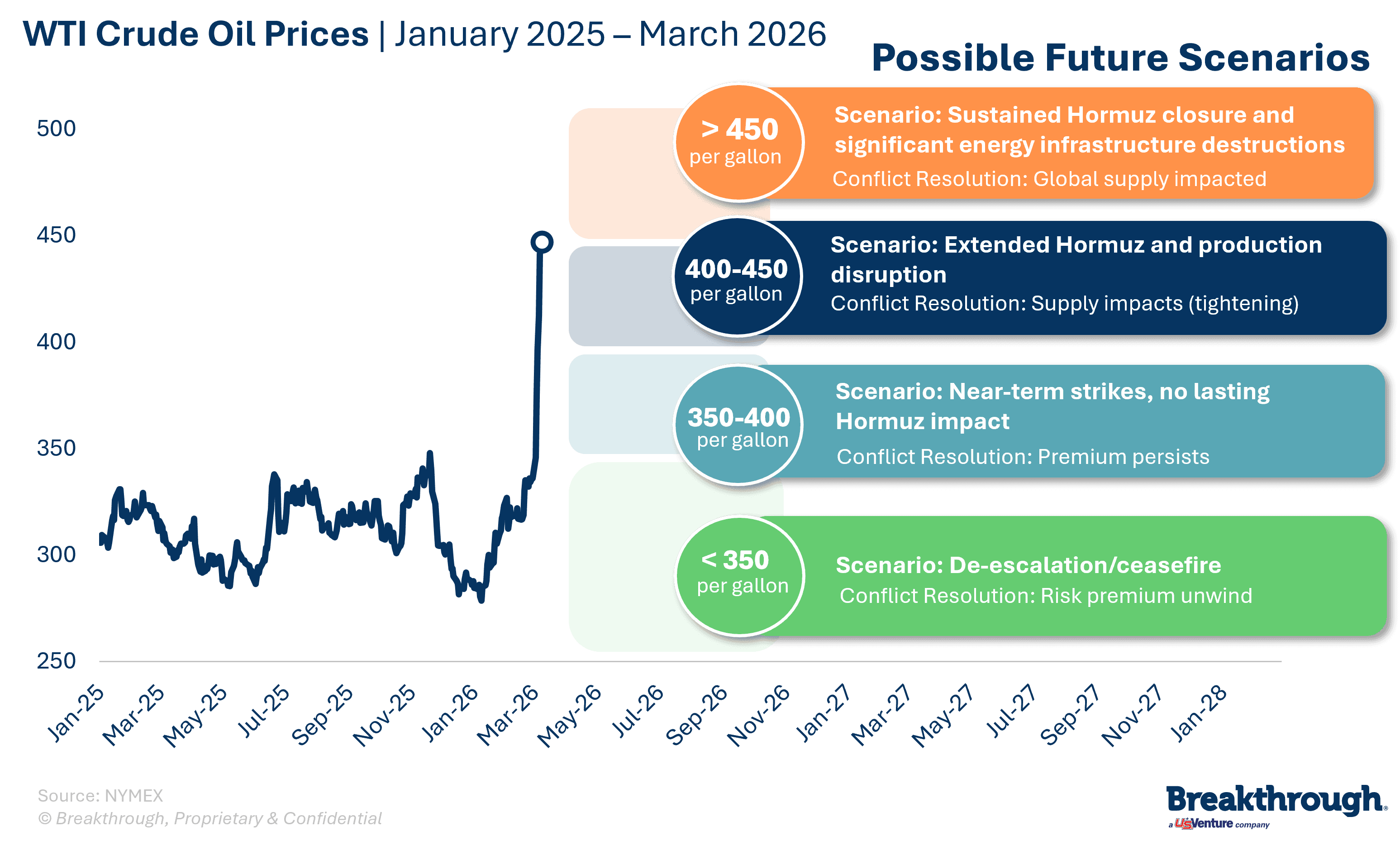
Together, these factors are not only constraining current supply, but also creating downstream ripple effects that will take time to resolve — even under an improved geopolitical backdrop.
If these conditions persist in the coming days, we would expect the market to remain anchored in this high cost scenario in the near term. Importantly, energy markets do not normalize immediately once disruptions ease. Physical supply chains, logistics flows, inventory rebuilds, and refinery operations require time to reset. As a result, even a sudden de-escalation or ceasefire would not translate into an immediate price recovery.
Historically, disruptions of this magnitude take weeks, not days, to unwind. Storage imbalances must correct, trade routes must reopen, and confidence must return to futures markets before prices can sustainably retrace. Until those processes are clearly underway, diesel prices are likely to remain elevated and highly volatile.
For shippers, this means near-term fuel costs should be planned with continued upside risk in mind, even if headline crude prices fluctuate lower on a day-to-day basis. The scenario framework is designed to evolve alongside the conflict, but for now, the costliest outcome is the one actively shaping diesel markets today.
The Iran War has fundamentally altered the energy landscape, creating unprecedented volatility and risk for shippers. With crude oil prices surging past $100 per barrel on Monday, March 9, and the critical Strait of Hormuz facing disruption, transportation budgets are under immense pressure. The conflict's impact is most pronounced on diesel and other essential transportation fuels. To navigate this uncertainty, shippers must adopt proactive, market-based fuel management strategies to ensure cost accuracy and protect their budgets from continued price shocks.
To gain control, shippers can leverage a market-based approach with Fuel Recovery and a risk management solution like T-Fuel. These strategies help ensure fuel reimbursements reflect the true cost of moving freight and allow shippers to lock in fuel costs to safeguard their budgets.
Breakthrough’s Research & Economics team is continuously monitoring these developments to provide expert insights. To get the latest analysis on how the Iran War is impacting energy markets, register for our live webinar on March 10 at 2 p.m. CT.
Forecasting diesel prices with precision is challenging due to high market volatility. We have developed four scenarios based on how the conflict evolves, with the market currently operating within our highest-risk scenario. Our second-highest scenario, which places wholesale diesel prices at or above $4.00 per gallon, reflects severe supply-side disruptions like the closure of the Strait of Hormuz and widespread production curtailments. On average, for every dollar per barrel that crude rises, we see about a 2.4 cents per gallon increase.
Diesel and other low-sulfur fuels are critical for both global commerce and military logistics. During a conflict like the Iran War, demand for these fuels increases for military use. Simultaneously, disruptions to global supply chains often lead to longer shipping routes, which increases overall commercial fuel consumption and puts additional upward pressure on diesel prices.
The Strait of Hormuz is a narrow waterway between the Persian Gulf and the open ocean. It is the world's most important oil chokepoint, with the U.S. Energy Information Administration (EIA) reporting that approximately 21% of global petroleum liquids flow through it daily. Any disruption or threat to passage in the Strait of Hormuz can severely constrain oil supply, leading to a rapid spike in global fuel prices.
Shippers can protect their budgets by moving away from static fuel surcharge schedules based on a national average index. A market-based fuel management solution like Breakthrough's Fuel Recovery, combined with a risk-management solution like T-Fuel, offers a strategic way to safeguard budgets. This approach ensures shippers pay a fair and accurate price for fuel based on real-time data, avoiding overpayment during periods of extreme market volatility.
Breakthrough's Expertise
Download our concise, one-page executive summary on the market impacts of the Iran War with your leadership team.

9 min read
March 6, 2026
Learn why natural gas, including CNG, LNG, and RNG, is a leading alternative to diesel and offers benefits like cost stability and lower emissions.
Read more
7 min read
March 5, 2026
Lower your fleet operating costs with fuel management best practices. Learn how benchmarking, strategic fuel purchasing, and operational insights can unlock significant savings.
Read more
9 min read
March 2, 2026
Escalating Middle East conflict is driving up crude oil and diesel prices. Learn how this geopolitical risk impacts fuel costs and how to manage the volatility.
Read more