5 min read
2024 State of Transportation Report
April 1, 2024
Share:
Table of contents
Browse the table of contents to jump straight to the part you’re looking for
Introduction
Extreme weather. Pressure to achieve aggressive sustainability goals. Carrier consolidation.
The transportation landscape has dramatically shifted over the past 12 months, and transportation teams’ priorities and pain points have evolved alongside it. One thing that hasn’t changed? The power of strong partnerships that create resilience in the face of growing uncertainty and emerging challenges.
Cost concerns have temporarily fallen by the wayside given soft capacity market conditions, but that may not last. Most transportation leaders expect linehaul rates to begin climbing before the end of 2024. At the same time, teams are facing service challenges due to volatile climate events against a backdrop of geopolitical conflict and heightened regulatory environment.
As transportation teams look to make progress toward ambitious emissions-reduction targets and navigate disruptions in the supply chain, shippers and carriers will need to work together to innovate and implement resilient strategies
Key Findings
Number one transportation challenge in 2024 is extreme weather events, according to shippers and carriers.
- 80% of transportation leaders believe the capacity market will tighten and rates will increase in 2024.
- 98% of shippers say their organization has set sustainability goals for transportation. 63% plan to fulfill specific sustainability certifications or standards.
- 51% of shippers and carriers say establishing relationships with new partners is a top goal for 2024.
Explore the 2025 State of Transportation Report
Check out the 2025 State of Transportation Report for the most up-to-date trends and insights.
Climate challenges surpass cost concerns as a top priority — for now
Transportation leaders predict an ominous forecast for 2024. Extreme weather events have emerged as the No. 1 transportation challenge for the next 12 months, according to both shippers and carriers. It makes sense: A months-long drought plaguing the Panama Canal, intensifying winter weather across the U.S., unprecedented flooding from atmospheric rivers in California, and continued fallout from a highly active hurricane season have already contributed to disruptions in 2024.
While it’s not surprising weather impacts are top of mind, it’s a marked change from 2023. Last year, inflationary pressures and an uncertain macroeconomic climate gave rise to fears about growing costs, particularly for fuel. A majority of transportation leaders (51%) cited volatile diesel fuel prices as the top challenge impacting their network in 2023.
This year, just 27% of transportation leaders say volatile diesel fuel prices are a top challenge, dropping it to the 5th most common concern.
Top challenges impacting networks, 2024 vs. 2023
| 2024 | 2023 | |||
 | 39% Extreme weather events (i.e., floods, hurricanes, tornadoes) |  | 51% Volatile diesel fuel prices | |
 | 36% Freight market contraction |  | 37% Limited freight capacity | |
 | 33% Emissions reduction goals/regulations |  | 36% Driver shortages | |
Cost has also fallen as a priority for shippers seeking carrier services — likely due to the soft capacity market that emerged in 2023. But at the same time, considerations tied to climate concerns and emissions reduction have risen on shippers’ priority lists, including sustainable or alternative energy shipping capabilities. In the current market, where cost is less of a concern, shippers are also more likely to look for carriers with more comprehensive capabilities. Most notably, shippers’ No. 1 priority when establishing carrier partnerships this year is add-on services, which suggests they are looking for carriers to do more while the market tilts in the shippers’ favor. Shippers are also seeking carrier partners who can help them up-level service quality and provide energy-efficient or alternative energy vehicles. This mirrors a trend in Breakthrough’s platform data. Increasingly, shippers are seeking information about carriers’ alternative energy capabilities and fleet fuel efficiency. This indicates shippers are more focused on the total value a carrier partner can provide, not just cost. However, the capacity market is expected to reverse in 2024, with shippers set to gradually lose the upper hand on cost as we head into 2025. Across shippers and carriers, 80% of transportation leaders believe the capacity market will tighten and rates will increase in 2024. But they are evenly split on how soon that will happen: 40% say tightening will occur in Q1 or Q2 and the other 40% say it will hold off until Q3 or Q4. |  |
Top 3 considerations for shippers when establishing carrier partnerships, 2024 vs. 2023
| 2024 | 2023 | |||
| Add-on services (e.g., warehousing) that enable me to consolidate vendors | | Cost | |
| On-time pickup/delivery reliability | | Capacity | |
| Sustainable or alternative energy shipping capabilities (tie) | | On-time pickup/delivery performance | |
| Innovative technology capabilities (tie) | |||
Whether or not the capacity market begins to tighten in 2024, one thing is clear: The transportation landscape will look markedly different by the time 2025 arrives.
Volatile climate events will further complicate a year that’s already seen unique transportation challenges. Geopolitical tensions, including the ongoing Red Sea conflict, have disrupted major maritime shipping routes, costing shippers time, money, and emissions progress. At the same time, higher regulatory standards for emissions — like the EU’s expansion of its Emissions Trading System (ETS) to include maritime emissions — require more resources to navigate. As the year progresses, transportation teams will need to remain agile and responsive in adapting to changing circumstances.
When does Breakthrough predict the capacity market to tighten?
We project capacity to remain relatively abundant through the end of 2024. While a soft market is advantageous to shippers, it can exert significant financial strain on certain carriers. In worst-case scenarios, some may cease operations. In the unfortunate event a carrier partner carriers. stops operations, you’ll need the ability to quickly search and vet new
Pro tip: The right SaaS solution enables you to pivot quickly when needs change. Capac-ID is a comprehensive productivity platform for shippers that provides transacted rate benchmarking, lane-specific carrier identification, and actionable recommendations to optimize your transportation strategy.
Sustainability is a high priority, but progress is gradualThe vast majority of shippers (98%) say their organization has established sustainability goals for transportation. While there are a mix of objectives, achieving or fulfilling specific sustainability certifications or standards is a goal for nearly two-thirds (63%) of shippers. A popular example of these standards is the Science Based Targets initiative (SBTi), which enables companies to set emissions reduction goals that align to objectives established in the Paris Agreement. Participating in the SBTi offers shippers the opportunity to track and report on emissions reduction progress while demonstrating accountability to consumers. At the same time, standards like the SBTi may feel more attainable than loftier goals like achieving net-zero emissions. To deliver on sustainability objectives like the SBTi, shippers are taking a variety of actions — but most appear to be in early evaluation and assessment stages. Half of shippers (50%) are taking action in 2024 by evaluating the potential emissions impact of alternative energy modes, the No. 1 tactic. More than 40% are also looking to optimize routes to minimize distance traveled and assess the cost and availability of transitioning select lanes to alternative energy modes. Continuing to tackle emissions with a portfolio approach of tactics will be especially critical as the regulatory environment evolves throughout 2024 and beyond. |  |
Shippers’ long-term sustainability-related transportation goals as of 2024
- 63% Achieving or fulfilling specific sustainability certifications or standards (e.g., science-based targets)
- 60% Achieving a specific percentage reduction in greenhouse gas emissions
- 50% Achieving net-zero emissions
- 45% Achieving carbon neutrality
With regulations like California’s Climate Corporate Data Accountability Act (SB 253) on the horizon, shippers will be required to track and disclose their scope 3 emissions as early as 2027. However, only 35% of shippers say they plan to track scope 3 transportation emissions in 2024, a misstep preventing them from setting benchmarks and identifying opportunities to reduce emissions. Shippers that begin tracking scope 3 emissions now can secure competitive relationships with energy-efficient carriers before new laws take effect and demand increases.
Locking in mutually beneficial partnerships is key since most shippers still act on cost rather than sustainability, despite a reduced focus on cost overall in 2024. Case in point: Only a fifth (21%) of shippers plan to switch to lower-emission transportation modes like rail this year. This aligns with Breakthrough’s projection that intermodal growth will remain slow due to competitive truckload rates. It also suggests shippers are looking to see evidence of sustained service improvements before fully committing to intermodal.
Is establishing a scope 3 transportation emissions baseline possible?
You can’t curb emissions when you lack information on the emissions intensity of each lane in your network. Luckily, gaining visibility into your scope 3 transportation emissions — and reducing them — is easier than it may seem. If you have the right partner.
Pro tip: With CleanMile, Breakthrough’s end-to-end emissions management solution, you can access a granular view of scope 1 and 3 transportation emissions for every individual load, not just your network as a whole. This enables you to pinpoint where and when emissions spikes occur and identify opportunities to reduce them.
On the other side of the equation, carriers are taking action to keep pace with shippers’ sustainability goals. They’re primarily focused on optimizing vehicle performance in a variety of ways to reduce emissions across their fleets.
However, carriers made less progress toward getting EVs on the road in 2023 than they hoped. Last year, 59% of carriers surveyed said they planned to add EVs by the end of 2023, but this year’s results show only 13% of carriers have already added EVs to their fleets. What’s behind the disconnect? A variety of macroeconomic factors are at play. Most notably, charging infrastructure hurdles and legal challenges delaying policies like California’s Advanced Clean Fleets regulation have stalled progress. Likewise, delayed production of battery-electric tractors, the higher cost of capital, and compressed margins are also contributing to setbacks.
Given the many challenges to getting EVs on the road, shippers and carriers should begin collaborating early on implementation strategies. With execution taking longer than expected, transportation leaders must plan for lengthy timelines and continue to explore a range of sustainability opportunities beyond EVs.
Shippers’ top 5 planned actions for making sustainability progress in 2024 | Carriers’ top 5 planned actions to reduce emissions in 2024 | |||
| Evaluate the potential emissions impact of alternative energy modes (e.g., EVs, biodiesel, hydrofuel) | | Implement fuel-efficient technologies in our vehicles | |
| Optimize routes to minimize distance traveled | | Conduct regular maintenance to ensure optimal vehicle performance | |
| Assess cost and market availability of transitioning select lanes to alternative energy modes | | Adopt electric or hybrid vehicles in our fleet | |
 | Contract with more sustainable carriers (e.g., SmartWay certified) |  | Optimize route planning to minimize fuel consumption | |
 | Track scope 3 transportation emissions |  | Implement driver training programs for eco-friendly driving practices | |
Carriers and shippers continue to prioritize partnerships
The need for strong collaboration extends beyond sustainability efforts. Relationship-building emerged as a key priority area for both shippers and carriers in 2023, and that trend holds steady in 2024.
However, there are nuances in how teams are approaching partnerships.
Last year, transportation professionals across shippers and carriers were most interested in nurturing existing partnerships. But in 2024, the primary focus has shifted to establishing relationships with new partners to increase efficiencies for more than half of transportation leaders (51%).
The most likely explanation for this shift is that shippers see opportunities to fortify their networks against future challenges while the capacity market is favorable. This mindset reflects transportation leaders’ expectations that volatile climate events will upend strategies in 2024 — a year that’s already seen significant disruptions. And with a number of consequential elections taking place in 2024, it makes sense that transportation leaders at both shippers and carriers are in search of the best partners to help them ride out the next wave of change.
All of these interconnected forces are playing out against a backdrop of historic transformation in the freight market. Recent mergers between major carriers have reshaped the logistics industry, influencing available capacity and creating new opportunities to diversify network relationships.
No. 1 focus area for transportation teams in the next 12 months, 2024 vs. 2023
| 2024 | 2023 | |||
| 51% Establishing relationships with new partners to increase efficiencies | | 70% Strengthening mutually beneficial transportation contracts with current partners | |
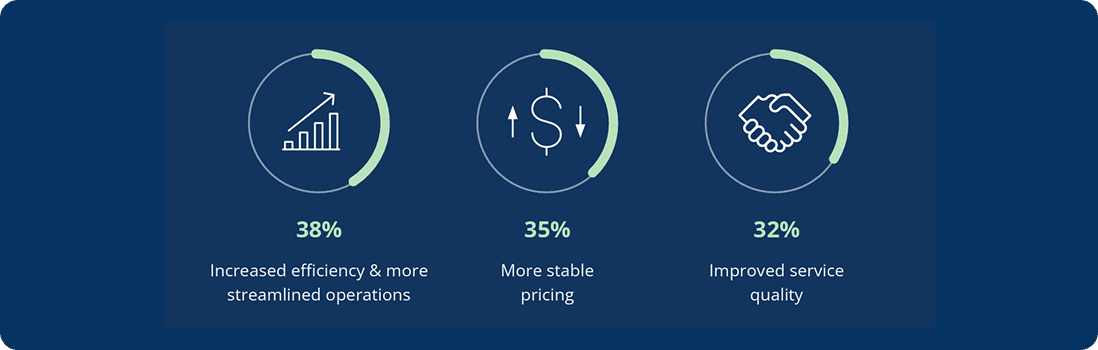
Transportation leaders generally see carrier consolidation as a positive trend. Roughly a third of both shippers and carriers expect to see increased efficiencies (38%), more stable pricing (35%), and improved service quality (32%) over the next 12 months [Fig. 1].
Yet, shippers continue to face regional hurdles in contracting carriers. A lack of relationships with carriers in certain geographies and the availability of specific equipment types in certain geographies remain top pain points. Likewise, shippers are seeking more information on industry-specific negotiated linehaul rates.
However, the right technology solution can help transportation leaders eliminate visibility gaps across their networks. Freight productivity solutions like Breakthrough’s Capac-ID can support shippers by providing information on regional carriers by lane, along with advanced rate benchmarking based on real transactions and personalized network recommendations.
Figure 1: Top 3 expected impacts of carrier consolidation over the next 12 months
From the carrier perspective, the most notable shift between 2023 and 2024 is around how relationships are forged. In 2023, 65% of carriers said professional relationships with shipper contacts were a consideration when establishing a partnership. In 2024, only 47% of carriers said the same. This change aligns with both shippers’ and carriers’ desire to seek out and cultivate new partnerships, as well as new opportunities emerging as a result of changes in the capacity and carrier markets.
Another sign shippers and carriers are looking to take advantage of the current freight market to secure favorable partnerships? They’re feeling less secure in their ability to overcome hurdles. In 2023, nearly two-thirds (62%) of transportation leaders strongly agreed they had access to the right tools and partnerships to effectively navigate transportation challenges. In 2024, the share of transportation leaders who strongly agree has dipped below 50%.
This decline in confidence may signal that expected transportation challenges in the year ahead — like volatile climate events — feel more unpredictable and less manageable than in the past. Strong partnerships and advanced data and analytics capabilities will be key to responding to disruptions and increasing agility throughout the transportation ecosystem.
Shippers’ top 3 hurdles to finding carriers that meet their needs, 2024 vs. 2023
| 2024 | 2023 | |||
| 57% Lack of relationships with carriers in certain geographies | | 49% Lack of information about available carriers | |
| 54% Lack of information on average negotiated linehaul rates for my industry | | 46% Availability of specific equipment types in certain geographies | |
| 48% Availability of specific equipment types in certain geographies | | 44% Lack of relationships with carriers in certain geographies | |
Carriers’ top considerations when establishing shipper partnerships in the next 12 months, 2024 vs. 2023
| 2024 | 2023 | |||
| 50% Equipment requirements | | 51% Equipment requirements | |
| 49% Payment terms | | 63% Payment terms | |
| 49% Sustainability requirements | | 51% Sustainability requirements | |
| 48% Fuel reimbursement rates | | 59% Fuel reimbursement rates | |
| 47% Professional relationships with shipper contracts | | 65% Professional relationships with shipper contacts | |
Overcoming challenges is easier with Breakthrough
The transportation management landscape is evolving at an accelerated rate — and only growing more complex. Unpredictable hurdles are coming your way, but so are new opportunities.
Breakthrough is the only technology partner that offers sustainable fuel and freight solutions. We’re uniquely positioned to provide the data, technology, and insights you need to gain a truly comprehensive view of your network and tackle interconnected objectives. Let us help you gather the lane-level data and real-time insights you need to move with agility, uncover cost savings, and make progress toward sustainability goals.
Methodology
Breakthrough surveyed 500 transportation decision-makers (including 350 shippers and 150 carriers) in the U.S. regarding their transportation goals, priorities, and predictions for the next 12 months. The survey was conducted January 2 through January 8, 2024.
Ready to build a resilient, sustainable transportation network?
Request a demo to discover the hidden opportunities to optimize your transportation operations for peak efficiency, sustainability, and reliability — and set the standard in your industry.

Download the report
Take the full 2024 State of Transportation Report with you. Download your copy to save these insights for future reference or to share them with your team.