
9 min read
April 9, 2026
Iran War: Energy Market Impact Tracker
Track the Iran War's impact on energy markets. Use our daily update and real-time insights to protect your transportation budget. Read the latest today.
Read more5 min read
February 23, 2026

Share:
Table of contents
Browse the table of contents to jump straight to the part you’re looking for
Geopolitical tensions between the United States and Iran have escalated in the past two months, introducing a significant risk premium into global energy markets and creating new challenges for supply chains. With U.S. national wholesale diesel prices rising $0.50 per gallon—an increase of about 20% since the beginning of the year—shippers are feeling the pressure of higher fuel costs. To effectively navigate this volatility, supply chain leaders must understand the core geopolitical drivers and their impact on their transportation budget.
The recent escalation in U.S.-Iran tensions has introduced a geopolitical risk premium that is directly responsible for raising fuel costs.
Current energy price volatility is being driven by the perception of risk surrounding potential supply disruptions, not an actual loss of supply.
Diesel prices are particularly sensitive to geopolitical developments in the Middle East due to their role in global freight and logistics.
The most significant upward risk to fuel prices stems from any disruption, whether real or perceived, to oil and refined product flows through the Strait of Hormuz.
Over the past several weeks, U.S. officials—including President Trump—have warned Iran of military consequences if it fails to curtail its nuclear enrichment program, setting a 10–15 day deadline for progress. In response, Iran has conducted joint naval exercises with Russia and temporarily restricted shipping traffic in portions of the Strait of Hormuz, the world’s most important oil chokepoint, during military drills.
While the partial closure was brief, the risk signal to markets was clear: Iran can disrupt flows through a corridor that handles roughly 20–30% of global seaborne crude oil and refined product trade. Even the perception of elevated risk at this chokepoint is enough to move prices materially.
Diplomatic efforts have resumed in Geneva – and are expected to continue during the final week of February – and have helped to temper immediate escalation fears. However, negotiations remain fragile, and the U.S. has continued to build military presence in the region, leaving markets in a “wait-and-see” posture.
Crude oil prices reacted quickly to the rising geopolitical risk. WTI crude oil prices climbed to six-month highs near $66-$67 per barrel, with analysts estimating that $4–6 per barrel of the January-February crude oil price rebound is attributed to the geopolitical risk premium tied to Iran.
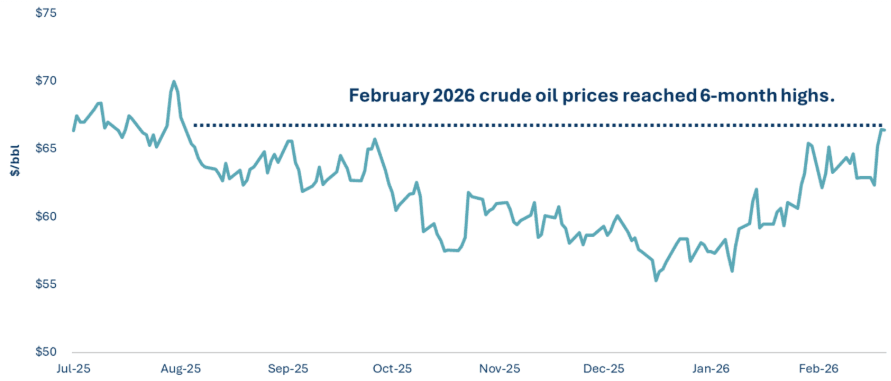
Importantly, this price increase has occurred without any actual supply disruption. Iran continues to export crude oil, and OPEC+ spare capacity remains available. This shows that recent price strength is being driven more by risk perception than physical scarcity.
Analysts broadly agree that a full closure of the Strait of Hormuz is unlikely, as it would also cripple Iran’s own oil revenues. However, even limited disruptions, harassment of shipping, or attacks on regional infrastructure could push oil prices sharply higher in a short period.
For shippers, the key takeaway is that diesel prices are likely to remain elevated and volatile as long as tensions persist. Diesel is more sensitive than gasoline to geopolitical risk because it is tied to global middle distillate balances and changes to routing for international supply chains. Recent crude price gains have already translated into firmer wholesale diesel prices, particularly in European and U.S. markets. Additionally, winter storms in the Northeast U.S. and enhanced European sanctions on Russian energy products have resulted in a premium for diesel prices on both sides of the Atlantic.
This environment reinforces the importance of maintaining visibility into fuel market dynamics and calculating fair and accurate fuel reimbursements according to the time, price, tax, and geography of each shipment. Fuel Recovery is designed to help businesses manage the complexities of fluctuating fuel costs by providing transparent and data-driven calculations. This ensures that reimbursements are fair, aligned with current market conditions, and tailored to specific operational needs. Learn more about Fuel Recovery, our market-based fuel reimbursement solution, today.
A $1 change in the price of crude oil typically results in a 2.4-cent-per-gallon increase in the price of diesel. Crude oil accounts for approximately 45-55% of the final price of diesel in the U.S.
Diesel price volatility is often more significant than crude oil price volatility during geopolitical events because distillates are globally traded commodities critical to freight and military logistics.
Most refined products are impacted significantly by the change in oil prices from intensifying geopolitical tension. Diesel, bunker fuels, and jet fuel are among the most profoundly impacted because of their close relationship as middle distillates, their current seasonal market tightness, and their strategic importance to militaries and supply chains.
Stay informed
Equip your team with expert analysis on geopolitical shifts and fuel trends to strengthen your transportation strategy.

9 min read
April 9, 2026
Track the Iran War's impact on energy markets. Use our daily update and real-time insights to protect your transportation budget. Read the latest today.
Read more
6 min read
March 31, 2026
Traditional fuel surcharge programs fall short. Learn how a market-based fuel reimbursement, calculated by the specific time, tax, price, and geography of each movement, can enhance transparency.
Read more
9 min read
March 30, 2026
Discover top freight RFP strategies to build a competitive advantage, reduce transportation costs, and foster strong carrier partnerships for a resilient network.
Read more