5 min read
The Case for Better Transportation Data
June 1, 2022
Share:
Table of contents
Browse the table of contents to jump straight to the part you’re looking for
Executive Summary
The world runs on data. Every step in the shipment process can be recorded, from the linehaul rate to the arrival time of the shipment. While the amount of data shippers can consume is valuable, it needs to be all-encompassing and organized properly to maximize the value to the organization – delivering cost savings and efficiency metrics.
In this report, we identify and address data collection challenges, draw attention to specific data sources that can add significant value, and how to act on insights found within a shipper’s ecosystem. Building a strong foundation of data is a good place to start, but what you do with that data is where the real change occurs.
Key Takeaways
- Organize data for actionable outcomes. Data, to be useful, must be accurate. The cleanest data is captured in real-time and details each step in the process.
- Facilitate the deployment of insights. Start a routine to validate and analyze data. Track data through KPIs that will offer the insights needed to make meaningful change.
- Build value. Embrace the opportunity to unlock insights and build value for your organization. Remember to celebrate the wins!
Age of Information or Misinformation: The Power of Clean Data
For transportation professionals, we commonly find ourselves in the position of either having too much data or not enough data to act on requests. When called upon to forecast fuel prices or provide information on performance compared to the industry benchmark, we commonly evaluate our data and realize it may not be sufficient to make an educated decision. This can be a result of the data showing a misleading story or not having the data to support the request – a situation most transportation professionals have encountered at some point in their career. But this does not need to be a limiting factor. Solutions exist for collecting and managing clean data.
Partners exist in the market that are experts in the transportation sector. They have tools that include artificial intelligence to make assumptions and coding software to connect transportation management system (TMS) fields. Yet, data is only as good as the person who manually enters the data or the system that processes the transaction. A flaw or bias in the data can dramatically skew data, being worse than having data to start with. While this is a common challenge among transportation professionals who continue to work in systems that do not accommodate the needs of today’s complex supply chain, we can each do our part to work toward collecting and processing clean and comprehensive datasets.
In the collection and process of information, there are key steps to ensure clean and actionable data:
- Minimize Bias: Be aware of and work to reduce reporting and automation bias, as these can significantly impact your deliverables. The quality and quantity of data can determine whether the outcome is relevant or irrelevant to your organization. Remember, artificial intelligence is only as good as the data you use to train it. Each number in a dataset tells a story—make sure it reflects the event accurately.
- Capture Real-Time Data: The cleanest data is captured in real-time and details each part of the transaction. While real-time, market-based data is often preferred, it can be challenging to obtain. Connecting with your TMS provider to understand your system’s capabilities is essential for building a clean and comprehensive dataset.
- Build Data-Driven Partnerships: Find partners who value a data-driven relationship. Building a clean and comprehensive dataset takes time, but the process can be smooth and efficient with the right transportation network partners. Partners who prioritize data-driven collaboration are more likely to participate fully in the journey, leading to higher levels of success.
Clean data will provide a solid foundation for data analytics. Connecting with your partners and team members to establish a standard operating process for data collection will help minimize misleading data and open the opportunity for a data-driven relationship. Partners who specialize in data analysis and management solutions can provide a valuable outside perspective to your new initiative.
Derive Industry Knowledge Through Multiple Sources
To gather knowledge on our respective industries and how we compare, we commonly rely on relevant sources to form our position in the market. Researching multiple news sources to educate our perspective is essential to a well-rounded view.
While it is quicker to read one source, it can result in a costly decision. Data-driven explanations are the most valuable as they provide weight to claims. Remember to evaluate the quality of data to understand the credibility of the source, how it was calculated, and the relevance of the data based on the period it was collected. For example, what may appear to be an increase in shipment volume is a plateau when evaluating a shorter period compared to a longer period.
Breakthrough shipment volume compared to the average 2019 baseline, spread indicated as index change. Shipment volume continues to experience fluctuation, but overall is maintaining a similar index change. The large, sudden dips coincide with holidays.
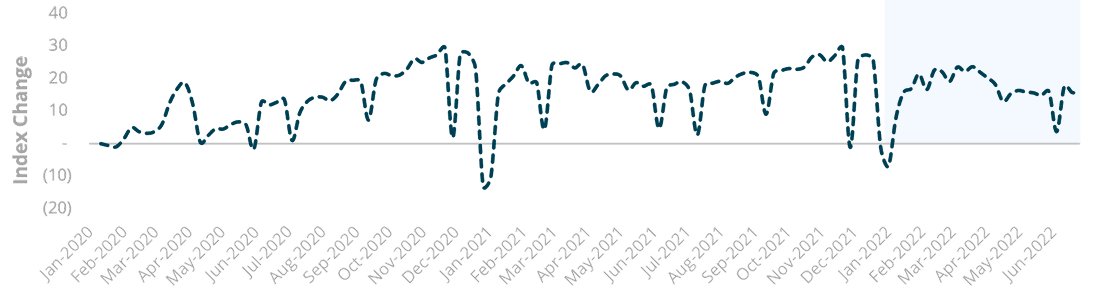
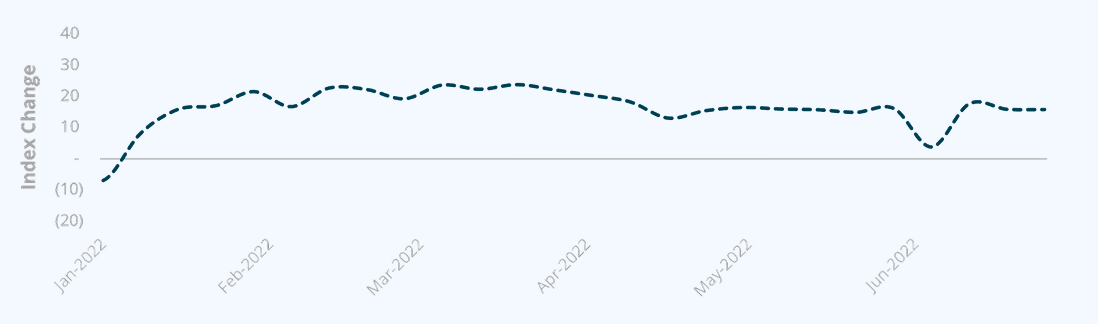
Breakthrough shipment volume compared to the average 2019 volume, spread indicated as index change. The large, sudden dips coincide with holidays. Notice when you look at a specific period—Jan-22 through Jun-22—the fluctuation doesn’t look as drastic.
The Advantage of Comprehensive Data
In many organizations, data is power. Data provides the ability to understand complex situations in presenting areas of success and opportunities for growth. Visualizations, built from datasets, allow companies to reflect on past decisions or events, benchmark against goals or industry averages, and anticipate upcoming challenges or opportunities through forecasts. Data is critical to an organization’s continued growth.
Yet, how does an organization grow its dataset to be a robust source of knowledge? Peter Drucker once said, “You can’t improve what you don’t measure.” In the transportation sector, specifically, it can be a challenge to get started on this journey and advance your systems to the complexity of the supply chain.
The first step in the journey is to understand the outcome you wish to achieve. Once you have a vision, you can work towards that goal either with your internal team or a partner. There are benefits to each process. In working with your internal team, they are knowledgeable about the strengths and weaknesses of the organization. In working with an external partner, they bring a complementary skill set to your team. Regardless of working with an internal or external partner, the desired outcome will define the data required to build a baseline and begin working toward the goal.
Value can be derived from each step of the supply chain. Connecting with your partners to understand the data they have or what they can record can deliver a competitive advantage to your organization. Often, external partners will be able to provide a list of data requirements with the value it will provide an organization. The best partners will have resources that can guide you to achieve optimal levels of performance.
Adding information to existing software may come at an additional cost, but the value is often worth the investment. Finding data-driven or like-minded partners will help facilitate the process. For strong, established partnerships, redefining the relationship will be rewarding for both parties as you enter a data-driven relationship.
In today’s world, clean and actionable data is always better. While it may be an overwhelming process, the key is to start a cadence of validating the data. To receive optimal results, communicate the transition and value of the desired outcome with the entire organization.
Clean and Comprehensive Data Boosts Profitability
Clean and comprehensive data sets the foundation for action. With clean and comprehensive data, you can improve process efficiency and productivity, reduce costs, and make informed business decisions. In data-driven companies and partnerships, data also acts as an intermediary to hold accountability at the center of the relationship.
At Breakthrough, we have a data council that spends 25% of its time on data clarity.
Data is often the cornerstone of organizational performance. We commonly become consumed in our daily tasks and projects that we lose track of the purpose, outcome, and impact of our efforts. Data at each level of the process can provide insight to understand if the project is on schedule, performing as expected, or needs additional support. Often, the software will recognize a deviation from the plan before you recognize it on your own. This automation eliminates the need for discovery and advances the team to move into the insights and action phase.
As the supply chain becomes more complex, insights and technology are being demanded at each step of the process. Collecting clean and comprehensive data is at the forefront of forming a data-driven strategy and retaining a competitive advantage in the market. While the journey to better transportation data may be challenging, it is advantageous to establish transparency, accuracy, and fairness with our partners to develop a strategic and sustainable relationship.
Ready to see how better transportation data can transform your network?
Discover how Capac-ID can help you leverage clean, actionable data to optimize your transportation network and drive smarter decisions.

Download the white paper
Take the full The Case for Better Transportation Data white paper with you. Download your copy to save these insights for future reference or to share them with your team.