
20 min read
September 30, 2026
Iran War: Energy Market Impact Tracker
Track the Iran War's impact on energy markets. Use our weekly update to protect your transportation budget. Read the latest today.
Read more6 min read
July 8, 2026

Share:
Table of contents
Browse the table of contents to jump straight to the part you’re looking for
Geopolitical conflict, tax changes, and market fluctuations make it difficult for traditional fuel surcharge programs in Mexico to keep pace. This diesel fuel volatility exposes your budget to risk and complicates carrier relationships, making the stakes especially high for supply chain, finance, and logistics leaders managing freight across Mexico. Fuel is one of the largest operating expenses in transportation, and Mexico fuel prices can fluctuate significantly, yet many programs still rely on static assumptions that fail to reflect what fuel actually costs on a given lane, on a given day.
To make informed decisions, shippers need greater awareness of diesel fuel price swings and how to build a fuel reimbursement strategy that reflects the realities of Mexico’s fuel market. This article breaks down what drives Mexico fuel prices, why traditional programs fall short, and how a market-based approach helps you regain control.
Geopolitical conflicts and domestic policy shifts continue to create an unpredictable environment for shippers managing freight in Mexico. Since the end of February, fuel costs have fluctuated 15% to 20%. While this is less severe than in some other global markets, it continues to be a challenge for supply chain leaders.
Unlike the U.S. market, Mexico fuel prices are heavily influenced by government intervention. The Sheinbaum administration actively uses two primary levers to manage costs for consumers and businesses.
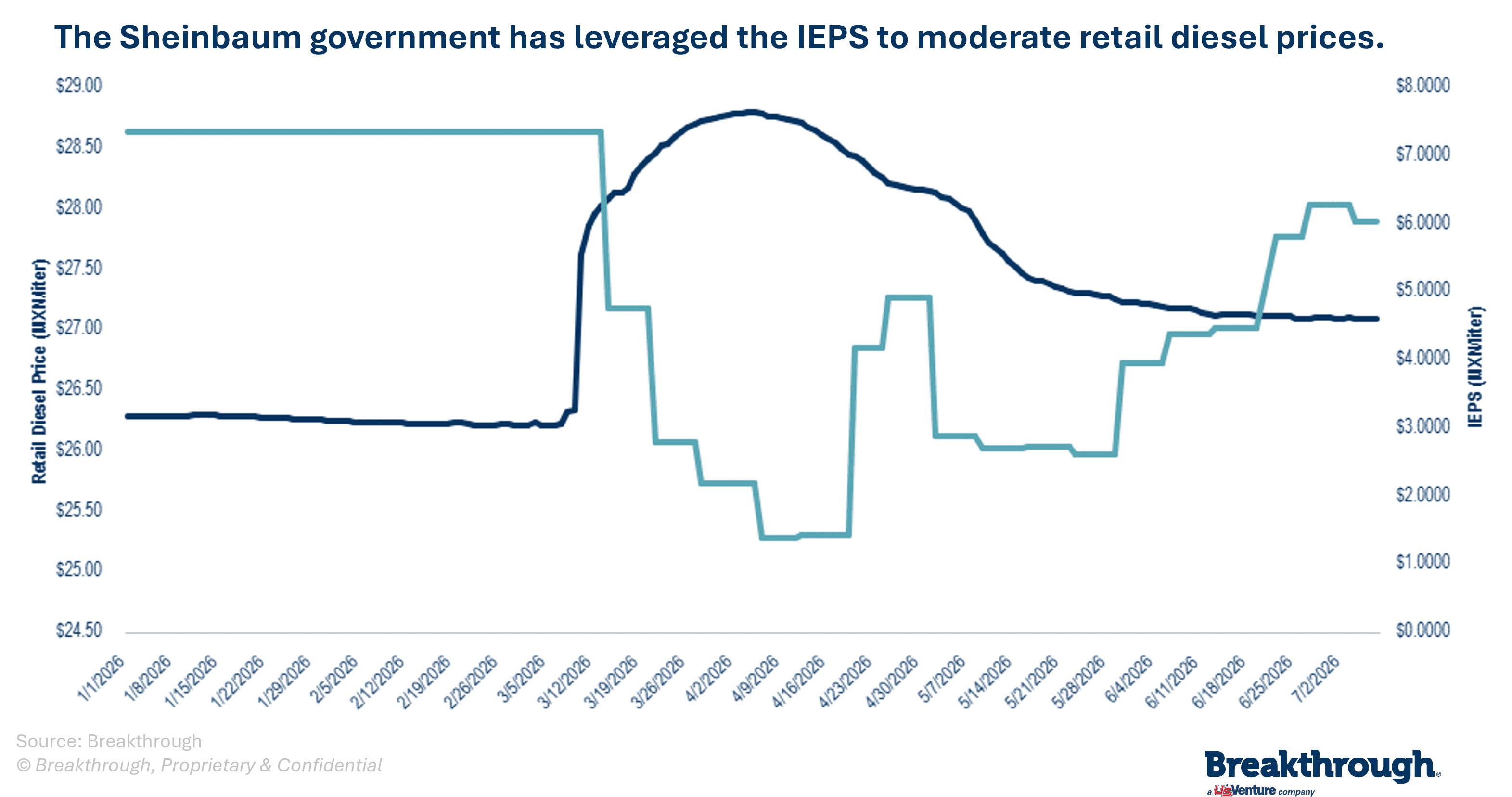
These interventions create downward price pressure when global costs rise, making Mexico’s fuel market unique.
Many companies transporting goods across the border default to U.S.-based fuel indices because they are easy to implement across these shipments. The challenge is that convenience does not always translate to accuracy. Mexico fuel prices respond to a different set of market and policy influences than those in the United States, creating a disconnect between what you pay and what carriers actually pay at the pump.
As a result, relying on U.S.-based inputs for cross-border shipments means fuel reimbursements may not reflect the true cost of fuel in the region.
Beyond global events and policy, several structural factors influence Mexico fuel prices:
Choosing an intra-Mexico fuel price methodology if accuracy matters more than convenience. The U.S. Department of Energy diesel fuel price index might be easier to apply, but it leaves your budget exposed to the gap between assumed and actual cost, a gap that widens every time the IEPS tax shifts or a price cap takes effect.
To achieve accuracy and transparency, shippers need a fuel management program that reflects the realities of the market. Breakthrough’s Fuel Recovery program was designed specifically for this purpose.
Our Mexico Fuel Recovery methodology calculates fuel reimbursements based on four core components:
We ingest data from over 10,000 fueling stations across Mexico daily. This allows us to calculate weighted, state-level price averages that reflect the actual cost of fuel along any given route on any given day. For cross-border shipments, this methodology is applied to the Mexican portion of the trip and combined with U.S. pricing for the stateside leg, ensuring a fair and accurate reimbursement for the entire movement.
The factors driving Mexico fuel prices, from geopolitical conflicts to tax changes, are not going away. What can change is how you respond. Continuing to use a traditional fuel surcharge program amplifies your risk. By moving toward a market-based approach, you can turn volatility from a risk into something manageable and create transparency for both you and your carrier partners. This allows you to manage costs effectively, strengthen relationships, and make data-driven decisions with confidence.
Learn more about how Breakthrough’s Fuel Recovery solution can bring accuracy and fairness to your transportation network.
The IEPS is a diesel excise tax that the Mexican government uses to stabilize prices. When global oil prices are high, the government can reduce the IEPS tax rate, which provides downward pressure on retail diesel prices. This intervention acts as a market shock absorber, making Mexico’s fuel price behavior distinct from other countries.
We recognize security is a major concern. Our program uses the distance agreed upon between the shipper and the carrier, which should account for any discrepancies in mileage to be reimbursed fairly for a secure route. If a route changes, we will adjust the logic in our system to ensure the distance is accurate and all parties can be confident in the fuel calculation.
Absolutely! It is common for shippers operating in Mexico to not have a formal transportation management system (TMS). We have developed solutions to process and price these shipments.
Fuel Recovery
Gain clarity on your transportation spend and control Mexico fuel prices with market-based reimbursements.

20 min read
September 30, 2026
Track the Iran War's impact on energy markets. Use our weekly update to protect your transportation budget. Read the latest today.
Read more
3 min read
August 12, 2026
Visit Breakthrough at booth 302 during CSCMP EDGE and hear Andersen Corporation share how data-driven insights help manage fuel volatility and rising costs.
Read more
7 min read
August 7, 2026
Learn how marine fuel procurement affects bunker fuel costs, BAFs, and ocean transportation spend, and discover how greater transparency can improve cost management.
Read more