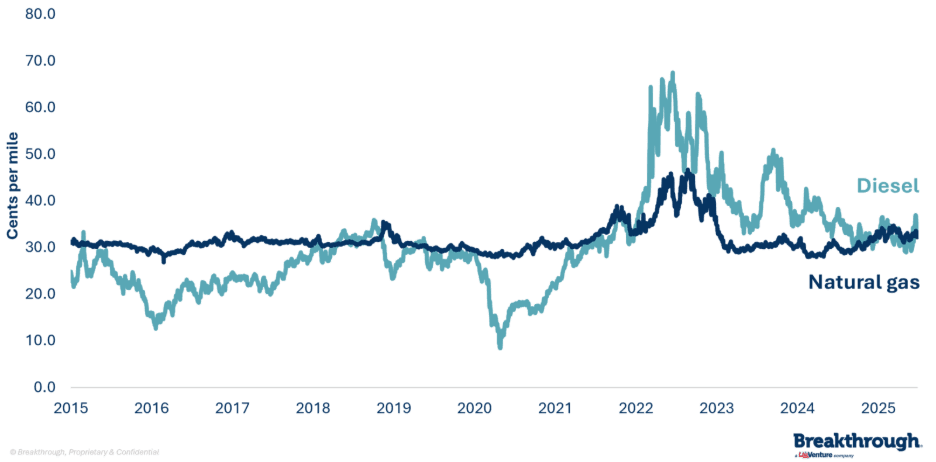
Transportation leaders no longer debate whether they should act on sustainability. Today, the core challenge is executing cost-effective sustainability initiatives that withstand real market pressure. Fleet operators must navigate unpredictable fuel prices, complex supply chains, and continuous global disruptions while maintaining strict budget discipline.
At the same time, alternative energy is attracting increased market attention. Investment in alternative fuel infrastructure is expanding rapidly, with renewable nautral gas infrastructure growing 35% since 2023, and hundreds of new stations under development to meet rising commercial demand. Sustainability investments with operational payoff are now central to building a resilient transportation strategy.
Leading organizations integrate these cost-effective sustainability initiatives directly into their core transportation plans. By focusing on targeted adoption and lane-specific deployment, financial leaders can reduce their exposure to diesel price shocks. Alternative energy solutions do not just reduce carbon outputs; they provide critical financial stability and network resilience in an increasingly unpredictable market.
Key takeaways
Alternative fuels like renewable natural gas (RNG) offer stable pricing, which insulates fleets from the volatility of the global diesel market.
State-level policies, especially on the West Coast, make alternative fuels increasingly cost-competitive and accessible.
A total cost of ownership model reveals the long-term economic benefits of clean energy adoption, moving beyond initial upfront asset costs.
Why does market volatility drive alternative fuel adoption?
Traditional diesel pricing has a long history of extreme volatility. Global market fluctuations, geopolitical conflicts, and supply chain bottlenecks frequently trigger unpredictable cost spikes. This constant instability creates a persistent tension between long-term emissions commitments and short-term financial accountability. For procurement directors and fleet managers, unpredictable diesel costs make accurate forecasting nearly impossible and create significant friction between financial and operational teams.
In contrast, alternative energy sources provide financial stability. RNG, for instance, is produced domestically and remains insulated from international market shocks. Transitioning a portion of your fleet to a multi-fuel network acts as a financial hedge against sudden diesel price increases. This strategic selectivity enables transportation leaders to maintain strict budget discipline while achieving their environmental targets.
By prioritizing the highest-return opportunities, organizations can deploy alternative energy in regions where fuel cost savings yield an immediate financial return. Pairing this approach with strategies to negotiate better fleet fuel discounts ensures every sustainability investment delivers a clear operational payoff, allowing companies to meet their climate goals without sacrificing their bottom line.
What are the practical pathways for alternative energy adoption?
Selecting the right alternative energy source requires a clear understanding of your specific operational needs. Transportation leaders should evaluate each fuel type based on its business role, infrastructure availability, and potential for cost-effective sustainability.
Renewable diesel: The immediate compliance solution
Renewable diesel is the most accessible starting point for fleets aiming for rapid emissions reduction. This fuel is a direct substitute for conventional diesel, meaning carriers can use it in existing engines without purchasing new vehicles or building new fueling infrastructure. From a financial perspective, renewable diesel allows organizations to meet strict regulatory compliance mandates quickly. While the per-gallon cost can sometimes exceed conventional diesel, targeted adoption in regions with strong tax incentives creates a highly favorable financial model. Choose renewable diesel for a quick win that doesn’t require capital investment in new equipment, especially in states with favorable economic conditions.
RNG: The high-utilization efficiency driver
RNG is the ultimate cost-stabilizing asset for high-mileage fleets. While purchasing compressed natural gas vehicles requires considerable upfront capital premium, the dramatic reduction in daily fuel expenses quickly offsets the initial purchase price. According to transportation experts, the fundamental success metric for RNG is asset utilization. The more miles a truck drives, the faster the organization recovers its capital investment. Fleet managers who use slip-seating strategies to keep vehicles moving around the clock achieve the highest return on investment. Choose RNG if your fleet operates on predictable, high-mileage regional routes where consistent fuel savings will outweigh initial equipment costs.
Commercial electric vehicles: The regional resilience asset
Commercial electric vehicles represent a critical investment for regional, short-haul freight operations. Widespread adoption for long-haul routes will take several years as national charging networks mature, but regional lanes present an immediate opportunity for cost-effective sustainability. Major investment in alternative fuel infrastructure is expanding across key freight corridors, such as the interstate routes connecting major West Coast distribution hubs. Electric vehicles drastically lower ongoing maintenance expenses and eliminate exposure to liquid fuel markets entirely. Choose commercial electric vehicles if your network includes predictable, short-haul return trips anchored by reliable terminal charging infrastructure.
How do regional policies shape alternative energy investments?
Government regulations and regional incentive programs dictate the economic viability of alternative energy. State-level clean fuel standards fundamentally alter the financial landscape, making alternative energy investments more competitive than ever before.
The West Coast leads the United States in creating favorable economic conditions for clean freight.
California, Oregon, and Washington have established rigorous carbon reduction frameworks that subsidize the cost of alternative energy sources.
In California, aggressive cap-and-trade systems and clean fuel reward programs push the price of renewable diesel to cost parity with traditional fossil fuels.
Adoption is building in the Midwest, where strong agricultural infrastructure ensures a robust supply of domestic biodiesel and RNG.
Emerging markets like New Mexico and Illinois are introducing their own clean fuel standards, signaling that the entire national market is shifting toward a low-carbon economy.
Understanding exactly where these financial subsidies overlap with your routing guide is the cornerstone of economically viable decarbonization.
How can shippers achieve cost parity with alternative energy?
A common objection to corporate sustainability initiatives is the perceived negative impact on organizational profitability. However, relying exclusively on initial purchase price data creates a distorted view of the actual financial impact. A comprehensive total cost of ownership model clearly demonstrates that sustainability investments are sound business decisions.
While purchasing RNG trucks or commercial electric vehicles requires upfront capital, the long-term fuel savings, reduced maintenance expenses, and government tax credits often result in a lower total cost of ownership compared to traditional diesel assets. Alternative energy is attracting increased market attention precisely because the math now favors early adopters who understand lifecycle asset valuation.
Achieving cost parity requires matching shipper demand with the right carriers. Financial leaders should look beyond their incumbent carriers and identify carriers that already operate alternative fuel vehicles in high-density freight lanes.
Starting with a highly focused pilot program minimizes financial risk while allowing operational teams to capture the tangible economic benefits of clean energy. As your organization builds confidence, you can gradually expand this targeted adoption across other optimal segments of your network. Structuring your investments through a formal transportation carbon reduction plan guarantees every step forward aligns with strict budget requirements and long-term corporate goals.
How do you execute a transportation emissions reduction strategy?
Executing a multi-fuel strategy requires a structured, data-driven decision framework. Before exploring new carriers or investing in new equipment for your private fleet, transportation leaders must calculate their absolute lifecycle emissions and establish a baseline grounded in primary or consumption-based data.
Here are the key steps that support effective emissions management and cost reduction strategies:
Identify where alternative fuels fit in your transportation network. Pinpoint lanes, regions, and carriers where fuels like renewable diesel or RNG are operationally and economically viable based on infrastructure and your routing guide.
Quantify cost vs. emissions impact. Model total cost of ownership and linehaul rate implications alongside emissions reduction to prioritize the lowest cost-per-ton opportunities.
Match your lanes with carriers and partners already adopting alternative energy today. Leverage market insight into carrier capabilities to connect you with companies already investing in alternative energy.
Plan and execute pilots. Implement targeted alternative energy pilots, such as converting to renewable diesel on select lanes or establishing dedicated RNG fleets, by following clear best practices for efficient and effective execution.
How can you start building a diversified energy portfolio today?
Transitioning to alternative energy sources is a critical business imperative. Building a multi-fuel transportation network reduces scope 3 emissions, stabilizes operational fuel budgets, and protects your entire supply chain from unpredictable global energy shocks. The transportation sector accounts for 28 percent of carbon emissions in the United States, meaning every mile your goods travel presents a tangible opportunity for optimization.
Breakthrough’s CleanMile solution is a comprehensive solution that helps shippers track, plan, and execute their emissions reduction strategies. By using a clear, data-driven methodology certified by the Smart Freight Centre in conformance with ISO 14083 and the GLEC Framework, CleanMile provides shippers with the effective emissions management and cost reduction strategies they need.
Shippers using the CleanMile platform have successfully increased their alternative energy utilization by 33 percent while reducing their overall emissions intensity by an average of six percent. These metrics confirm that combining clean, load-level data with market expertise yields significant environmental and financial returns.
Frequently asked questions about the cost of alternative energy sources
What is the actual cost difference between alternative energy and diesel?
The cost variance depends entirely on the fuel type and the geographic region. Commercial electric vehicles require higher initial capital investments but offer much lower ongoing fuel and maintenance costs. Renewable diesel often reaches immediate cost parity with conventional diesel in states with aggressive clean fuel standards, such as California and Oregon.
How long does it take to see financial returns from alternative energy?
The timeline for financial returns varies based on your specific strategy. Switching a dedicated lane to a carrier that already uses renewable diesel provides immediate emissions reductions with zero capital investment. Purchasing electric vehicles or RNG trucks typically requires three to five years to achieve a positive return on investment through sustained fuel savings.
What are the operational risks of transitioning to a multi-fuel network?
The primary risk involves infrastructure availability. Deploying electric vehicles or RNG trucks in regions without adequate infrastructure can disrupt delivery schedules. Organizations mitigate this risk by partnering with strategic transportation partners, like Breakthrough, to map alternative energy infrastructure and carriers with alternative energy equipment to your routing guide and using lane-specific deployment.
Who should consider adopting RNG for their fleet?
RNG is a strong fit for shippers and carriers with predictable freight patterns, regional or repeatable lanes, and access to natural gas fueling infrastructure. It is especially compelling for organizations that want a cost-effective way to reduce emissions without waiting for other alternative energies to fully scale. RNG can be particularly attractive when fleets already operate natural gas equipment, work with carriers that do, or can leverage partnership-based fuel pricing to improve economics. For transportation leaders balancing cost control with sustainability progress, RNG is often most effective as a targeted deployment strategy in the right lanes rather than a full-network shift.
CleanMile
Questioning your path to lower emissions?
Take control of your scope 3 emissions with data-driven strategies.
Learn how marine fuel procurement affects bunker fuel costs, BAFs, and ocean transportation spend, and discover how greater transparency can improve cost management.