
21 min read
October 21, 2026
Iran War: Energy Market Impact Tracker
Track the Iran War's impact on energy markets. Use our weekly update to protect your transportation budget. Read the latest today.
Read more8 min read
July 23, 2026

Share:
Table of contents
Browse the table of contents to jump straight to the part you’re looking for
Diesel markets can shift from stable to volatile in an instant. The collapse of the U.S.-Iran memorandum of understanding on July 8, 2026, triggered a series of developments that have pushed crude oil and diesel prices to their highest levels in months. Houthi forces have since attacked two Saudi oil tankers in the Red Sea, Iran has declared the Strait of Hormuz effectively closed, and Goldman Sachs has warned that Brent crude could exceed $120 per barrel by Q4 if disruptions persist.
For shippers managing transportation budgets, the timing is challenging. Fuel is already the second-largest and most volatile operating expense in transportation. A disruption of this scale, arriving mid-year, puts pressure on business margin plans that were built on different market assumptions.
This post breaks down exactly what is happening, why diesel prices are rising, and what supply chain leaders can do right now to protect their fuel spend. For weekly price updates, follow our Energy Market Impact Tracker.
The U.S.-Iran memorandum of understanding had functioned as a fragile diplomatic ceiling on hostilities. Its collapse on July 8 removed that ceiling. Within hours, market sentiment shifted. Crude oil contracts moved higher as traders began pricing in the risk of sustained supply disruption rather than a temporary spike.
The breakdown signaled something more consequential than a failed negotiation. It indicated that the framework keeping regional tensions in check had dissolved, leaving energy markets exposed to the full range of escalation scenarios.
Following the MOU's collapse, Houthi forces attacked two Saudi oil tankers operating in the Red Sea. These attacks reintroduced a risk that had briefly receded: the vulnerability of critical maritime shipping corridors to sustained military pressure.
The Red Sea is one of the world's most important routes for oil and refined product flows. Disrupting it compounds pressure on global supply chains that are still recalibrating from prior shocks. The U.S. has vowed to retaliate against further attacks, adding another layer of geopolitical uncertainty to an already volatile market.
Iran's claim that the Strait of Hormuz is "completely closed" represents the most severe threat to global energy supply in the current conflict. The Strait is the world's most critical oil chokepoint. According to the U.S. Energy Information Administration, approximately 21% of global petroleum liquids flowed through it daily before the conflict began.
A sustained closure does not just tighten crude supply. It makes it challenging to move product out of the Middle East, increases shipping costs, raises insurance premiums, and creates downstream shortages of refined products, including diesel. Even the threat of closure is enough to embed a persistent risk premium into prices.
The market response has been swift and significant. Brent crude topped $100 per barrel for the first time since late May 2026, a gain of roughly 40% within the month. WTI has risen above $90. Wholesale ultra-low sulfur diesel (ULSD) is climbing in tandem, with $5 per gallon wholesale diesel back within sight for the first time since May.
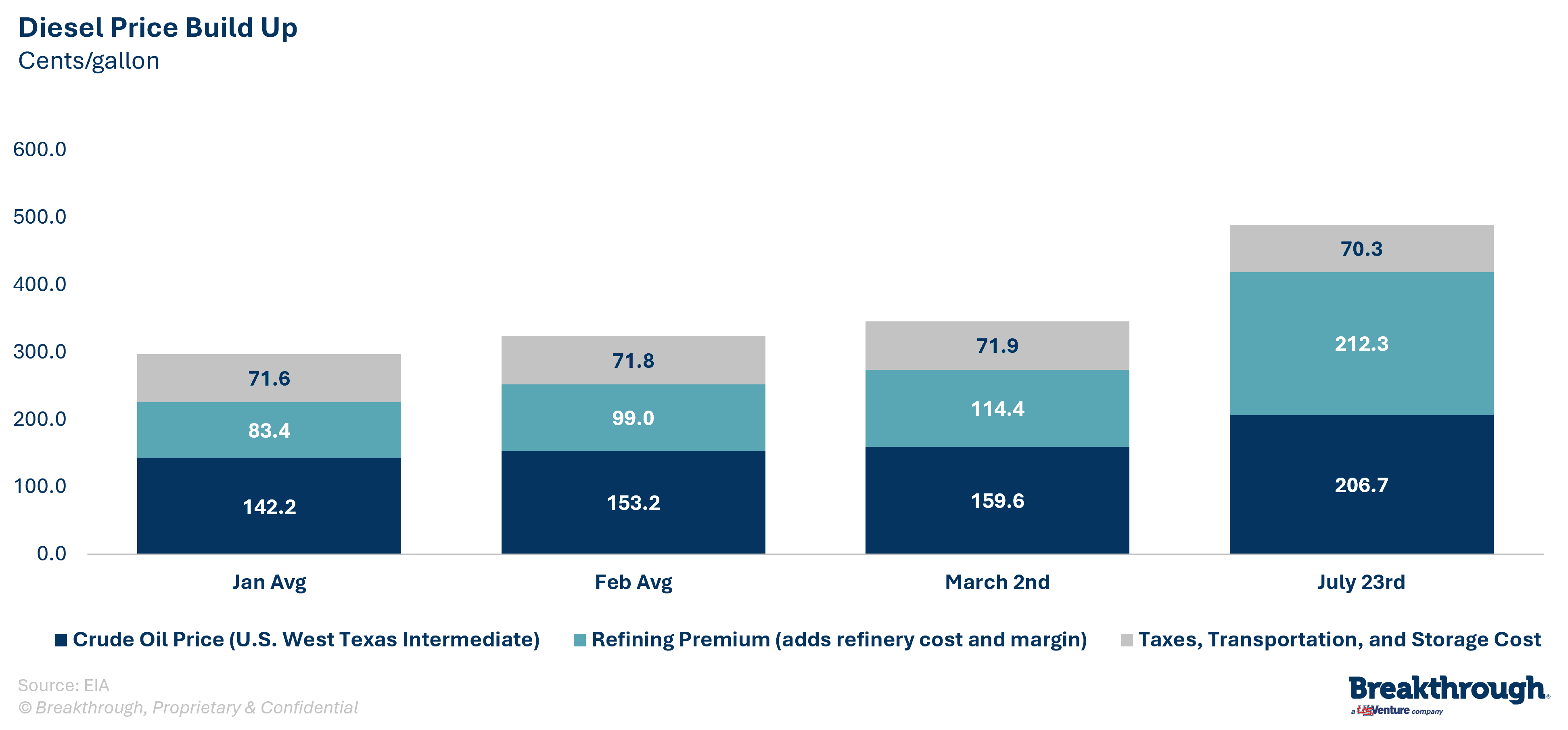
These are not marginal moves. A 40% month-over-month surge in Brent crude has direct and immediate consequences for transportation costs across every mode. Shippers who locked in freight rates or fuel surcharge schedules based on the market conditions of late May are now facing a meaningful gap between anticipated and actual fuel costs.
While crude oil typically drives most of the diesel price story, recent market dynamics have shifted that narrative. In a historically rare turn, refinery margins have been the dominant force behind diesel prices.
As Breakthrough's Research and Economics team shared earlier in 2026, refinery margins surged to roughly 40% of the diesel cost buildup during periods of acute disruption, compared to a historical average of 20% to 25%. When both crude prices and refinery margins expand simultaneously, the pressure on diesel costs is compounded.
Several structural factors contribute to why diesel prices are rising right now:
The result is a fuel market where modest supply disruptions can produce outsized price swings. The current disruption is not modest.
Budget uncertainty is the most immediate concern for shippers. Fuel spend that was forecast at one level now needs to be recalculated under a materially different market condition. The challenge is compounded when you factor in how most fuel reimbursement strategies are structured. Traditional fuel surcharge schedules that use the Department of Energy's (DOE) weekly retail diesel price index, use a national average that lags behind daily fuel price flucuations. During periods of rapid price escalation, this lag consistently produces inaccurate reimbursements, exposing shippers' and carriers' budgets to unnecessary risk.
Breakthrough's Fuel Recovery solution replaces the DOE index with a real-time, lane-level approach. Rather than using a weekly retail national average, Fuel Recovery calculates reimbursements based on four core components: time, price, tax, and geography.
The impact is significant. Fuel Recovery delivers an average 20% reduction in truckload fuel spend and a 40% reduction in intermodal fuel spend compared to standard fuel surcharge schedules. The fundamental difference between Fuel Recovery and a DOE-based fuel surcharge schedule is accuracy. When markets move as quickly as they are moving now, reimbursements built on last week's national average are already out of date. Fuel Recovery keeps reimbursements anchored to the actual cost of fuel on the specific lane and day of the movement.
For shippers who need a mechanism to manage future price exposure, Breakthrough's T-Fuel solution provides fuel price risk management capabilities. T-Fuel allows shippers to lock in fuel costs, limiting their exposure to further upward moves in a market that Goldman Sachs has suggested could have significant additional runway to the upside.
Together, Fuel Recovery and T-Fuel give supply chain leaders two complementary tools: one that ensures accuracy in current reimbursements, and one that provides a strategic buffer against ongoing price volatility.
The Iran-Saudi escalation and Houthi attacks on Red Sea tankers represent a fundamental repricing of geopolitical risk in the global energy market, and diesel is absorbing the impact in real time. Brent crude topping $100 per barrel, WTI rising above $90, and Goldman Sachs projecting potential $120 crude by Q4 all point in the same direction: shippers who rely on weekly average fuel surcharge schedules are operating with a tool that was not built for this environment.
Breakthrough's Research and Economics team monitors these developments daily. To learn how Fuel Recovery and T-Fuel can protect your transportation budget from continued diesel price volatility, contact Breakthrough today.
Diesel prices are rising in July 2026 primarily because of three interconnected events: the collapse of the U.S.-Iran memorandum of understanding on July 8, subsequent Houthi attacks on Saudi oil tankers in the Red Sea, and Iran's claim that the Strait of Hormuz is effectively closed. These events have driven Brent crude up roughly 40% in a single month, topping $100 per barrel, with wholesale diesel prices approaching $5 per gallon.
The most effective approach combines two strategies. First, replace DOE-index-based fuel surcharge schedules with a market-based reimbursement solution like Fuel Recovery, which uses lane-level wholesale prices updated to reflect the week of shipment. Second, implement a fuel price risk management solution like T-Fuel to lock in fuel costs and limit exposure to further upside moves in a volatile market.
Fuel Recovery
Fuel Recovery replaces fuel surcharge schedules with real-time, lane-level fuel reimbursements that reflect what fuel actually costs to move your freight.

21 min read
October 21, 2026
Track the Iran War's impact on energy markets. Use our weekly update to protect your transportation budget. Read the latest today.
Read more
12 min read
October 6, 2026
The October 5 executive order defers federal tax on dyed diesel used on-highway through December 31, 2026. Learn what it changes, what it does not, and how it affects fleet fuel programs.
Read more
3 min read
August 12, 2026
Visit Breakthrough at booth 302 during CSCMP EDGE and hear Andersen Corporation share how data-driven insights help manage fuel volatility and rising costs.
Read more