Recent escalations in the Middle East conflict have sent shock waves through global energy markets, causing a surge in crude oil and diesel prices. This volatility creates significant budget uncertainty and cost pressures for shippers who rely on stable fuel expenses to move goods.
To navigate this challenging environment, it is crucial to understand the market dynamics at play and adopt a strategic approach to fuel management.
Key takeaways
The recent escalation in the Middle East conflict has introduced a significant "war premium" to global energy prices, causing crude oil, natural gas, diesel, and other transportation energy costs to rise sharply.
Heightened risk to maritime trade through the Strait of Hormuz, a chokepoint for approximately 20% of the world's oil supply, is a primary driver of the price increases.
Retaliatory attacks are also targeting regional infrastructure, disrupting the production and distribution of energy products.
Low-sulfur fuels used in freight transportation are experiencing notable price volatility due to their importance in military and global logistics.
Shippers should anticipate sustained pressure on transportation budgets and prepare for higher near-term fuel costs, even in the absence of significant supply disruptions.
Geopolitical context: A market-shifting event
On February 28, 2026, coordinated military strikes by the United States and Israel on Iranian targets resulted in the confirmed death of Iran’s Supreme Leader, Ayatollah Ali Khamenei. This historic escalation in the Middle East conflict immediately repriced geopolitical risk across global energy markets.
As markets opened, they began pricing in several critical risk factors:
The potential for Iranian retaliation against U.S. or allied assets.
The possibility of disruptions to oil exports from the Persian Gulf.
Direct threats to tanker traffic through the strategic Strait of Hormuz.
As of the morning of March 2, regional attacks on energy infrastructure and supply chain bottlenecks, including cargo loading disruptions, are impacting global prices for crude oil, refined products, and natural gas.
Crude oil market reaction from the Middle East conflict
The impact on crude oil prices was immediate and significant. Between February 27 and March 1, the market reacted to the escalating Middle East conflict.
Brent crude oil surged from a settlement of $72.48 per barrel on February 27 to a high of $78.32, an increase of approximately 7.5%.
West Texas Intermediate (WTI) crude oil rose from around $67.02 per barrel to a high of nearly $72.00.
This spike added a risk premium of roughly $5 to $6 per barrel to global benchmarks over a 48-hour period. In total, analysts suggest that about $10 per barrel of risk premium has been added to crude oil since tensions began intensifying in January. This risk premium passes directly onto refined products, like diesel and gasoline, pushing their respective prices higher by about 2.4 cents per gallon with every $1 per barrel increase in crude oil prices.
Impact on diesel and refined products
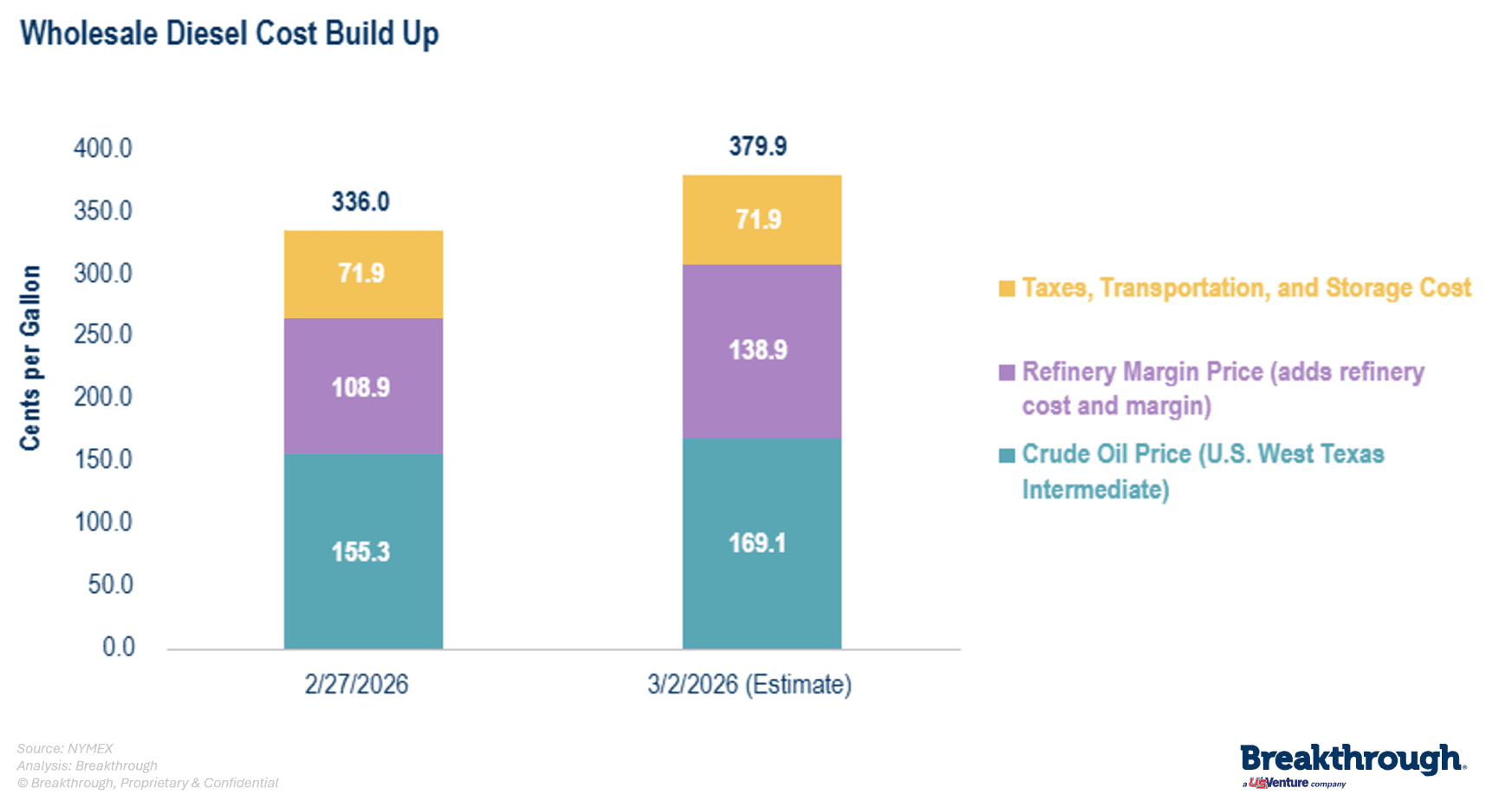
The conflict’s impact extends directly to the refined products that power transportation. U.S. ultra-low sulfur diesel futures, a proxy for wholesale diesel, climbed by approximately 10% in early trading following the news. This means diesel commodities saw a significant price increase per barrel in addition to the underlying increase in crude oil prices.
The chart above shows that diesel’s wholesale price will rise more from a significant spike in its refinery premium than the underlying increase in the price of crude oil. Other low-sulfur transportation fuels are experiencing a similar price spike. The impact to gasoline prices, thus far, has been milder because gasoline refinery margins or cracks have been essentially flat. This leaves only the increase in crude oil prices as the source of upward price pressure for gasoline, resulting in an increase of roughly $0.10 per gallon.
What to monitor in the Middle East conflict
As the situation unfolds, several factors will influence the future of fuel prices, and historical precedent shows that even short-lived conflicts can have a lasting impact on crude oil markets. In summary, Head of Global Commodities Research at JPMorgan, Natasha Kanev, framed the scope and magnitude of impact for energy prices through four variables, “how much energy is physically disrupted, how long the disruption lasts, whether credible replacement supply – including releases from the strategic petroleum reserves – can be mobilized quickly, and what comes next.” The following scenarios offer guidance.
The extent of Iranian Retaliation: Actions targeting Gulf shipping lanes or energy infrastructure will push prices higher. The 2019 drone attack on Saudi Arabia's Abqaiq and Khurais oil facilities, for example, temporarily knocked out 5% of global supply and caused WTI prices to surge by over 14% in a single day.
Strait of Hormuz Security: This chokepoint is critical for global energy security. During the 1980s "Tanker War," attacks on vessels in the Strait led to significant volatility and a structural increase in shipping insurance premiums. Changes in these rates and tanker availability will be early indicators of escalating risk.
Duration of Conflict: The length of military action will be a key determinant of price impact. A short-lived conflict, like the initial phase of the 2003 Iraq War, may see prices retrace after an initial spike. However, a prolonged campaign, similar to the multi-year instability following the Arab Spring in 2011, would embed a higher structural risk premium into fuel forecasts, keeping WTI prices elevated for an extended period.
Scenario
Conflict Resolution
WTI Impact
De-escalation/ceasefire
Risk premium unwind
$55-$65/bbl
Near-term strikes, no lasting Hormuz impact
Premium persists
$65-$75+/bbl
Extended Hormuz and production disruption
Supply impacts (tightening)
$80-$90/bbl
Sustained Hormuz closure and significant energy infrastructure destruction.
Global supply impacted
$90-$100+/bbl
Navigate fuel price volatility in your transportation network
The escalation in the Middle East conflict represents a significant shift in geopolitical risk that has directly impacted energy markets. Crude oil, gasoline, and diesel prices have risen sharply, and transportation budgets now face higher near-term fuel price risk. Low-sulfur fuels consumed by trucks, trains, and ships are experiencing the most significant volatility. Our Research & Economics team continuously monitors energy and freight market dynamics to provide expert insights. We will continue to track developments in the Middle East to help you navigate this evolving situation.
Especially in volatile environments, shippers must move beyond traditional fuel surcharge programs and adopt strategies that provide transparency and accuracy. Even without a physical supply disruption, the initial increases in crude oil and low-sulfur fuels will lead to meaningfully higher transportation energy costs. These events are adding pressure to shipper and fleet budgets for an uncertain duration, making accurate fuel cost management more critical than ever. By leveraging a market-based approach with Fuel Recovery, shippers can better navigate volatility and ensure their fuel reimbursements reflect the true cost of moving freight.
Frequently asked questions about the Middle East conflict
How does the Middle East conflict affect fuel costs?
The Middle East conflict creates uncertainty about the stability of the global oil supply, particularly from the Middle East. In response, energy markets price in a "risk premium," which increases the cost of crude oil and refined products like diesel. This is driven by fears of potential supply disruptions, threats to shipping routes like the Strait of Hormuz, and broader geopolitical instability.
Why is diesel fuel often more affected by conflict?
Diesel and other low-sulfur fuels are critical for global commerce and military logistics. During the Middle East conflict, the demand for these fuels can increase for military operations. Furthermore, expected disruptions to global supply chains often lead to longer shipping and air routes, which increases overall fuel consumption and puts additional upward pressure on diesel prices.
What is the Strait of Hormuz, and why is it important for fuel prices during the Middle East conflict?
The Strait of Hormuz is a narrow waterway between the Persian Gulf and the open ocean. It is the world's most important oil chokepoint, with approximately 20% of global petroleum liquids flowing through it daily. Any disruption or threat to passage in the Strait of Hormuz during the Middle East conflict can severely constrain oil supply, leading to a rapid spike in global fuel prices.
How can shippers protect their budgets from Middle East conflict-related fuel price volatility?
Shippers can protect their budgets by moving away from fuel surcharge schedules based on the DOE index. A market-based fuel management solution like Breakthrough's Fuel Recovery solution calculates reimbursements using real-time data based on the specific price, time, taxes, and geography of each freight movement. This ensures shippers pay a fair and accurate price for fuel, avoiding overpayment during periods of extreme market volatility.
Fuel Recovery
Fuel Market Dynamics are Shifting Due to the Middle East Conflict
Fuel Market Dynamics are Shifting Due to the Middle East Conflict
Explore how escalating U.S.–Iran tensions are impacting global energy markets, driving volatility in crude oil and diesel prices, and increasing supply chain risks.
The Supreme Court has ruled against the use of IEEPA tariffs. Understand the decision, the administration's response, and the impact on your supply chain.
How to Develop Cost-Effective Sustainable Transportation Strategies
Explore practical sustainable transportation strategies that reduce emissions and costs. Learn how to balance sustainability goals with operational efficiency.