
21 min read
October 21, 2026
Iran War: Energy Market Impact Tracker
Track the Iran War's impact on energy markets. Use our weekly update to protect your transportation budget. Read the latest today.
Read more6 min read
March 12, 2026

Share:
Table of contents
Browse the table of contents to jump straight to the part you’re looking for
Geopolitical events, like the Iran War, create significant volatility in the global energy market, leading to sharp increases in diesel prices. For shippers in Europe, this instability exposes a critical flaw in traditional transport agreements: outdated fuel reimbursement models. When carriers face skyrocketing costs at the pump, but their compensation is based on monthly or quarterly averages, they are forced to absorb unsustainable financial losses. This situation strains partnerships and puts your supply chain at risk.
The solution is to adopt a data-driven, market-based approach to fuel reimbursement. By separating fuel from transport charges and using weekly data, shippers can ensure payments are fair, accurate, and reflective of current market conditions. This not only protects carrier relationships but also provides the budget certainty needed to navigate turbulent times.
The global energy market is highly volatile, and geopolitical conflicts can cause sudden and dramatic swings in fuel prices.
Traditional transport contracts that update fuel costs monthly or quarterly fail to keep pace with rapid price changes, leaving carriers financially exposed.
Breakthrough’s Fuel Recovery program for Europe updates weekly, ensuring carriers are reimbursed closer to the actual price they pay at the pump.
Adopting a fair and accurate reimbursement strategy strengthens carrier partnerships and protects your transport budget from market instability.
The recent events involving the U.S., Israel, and Iran have sent ripples across the global energy market, directly impacting European diesel prices. For shippers, managing the resulting cost fluctuations is a major challenge. Here is a step-by-step guide to navigating this complex environment.
When diesel prices surge unexpectedly, carriers bear the immediate financial burden. As former carrier and current Breakthrough expert Andreas explains, carriers often see costs go "through the roof." A traditional diesel clause in a contract, which is calculated retrospectively, "doesn't help at this very moment."
If diesel costs, which account for about 30% of a carrier's total cost, increase by 20%, their overall expenses jump by six percent. With typical profit margins in European land transport hovering around 1.5–2%, such a spike is not just a minor issue—it threatens their existence.
Most diesel clauses adjust on a monthly or even quarterly basis. In a stable market, this might be adequate. However, during periods of extreme volatility, this lag creates a significant gap between what carriers pay for fuel and what they are reimbursed.
"Normally diesel clauses are on a quarterly basis," Andreas notes. "Taking into account a quarterly diesel clause calculation means that by end of March, the average of the first quarter is calculated." If prices spiked in the last few weeks of the quarter, the average will not reflect the carrier's actual costs, leaving them under-compensated for weeks or months. This inefficiency is highlighted in our analysis, which shows how transport rates can increase even as market energy costs decline, leading to inaccurate reimbursements.
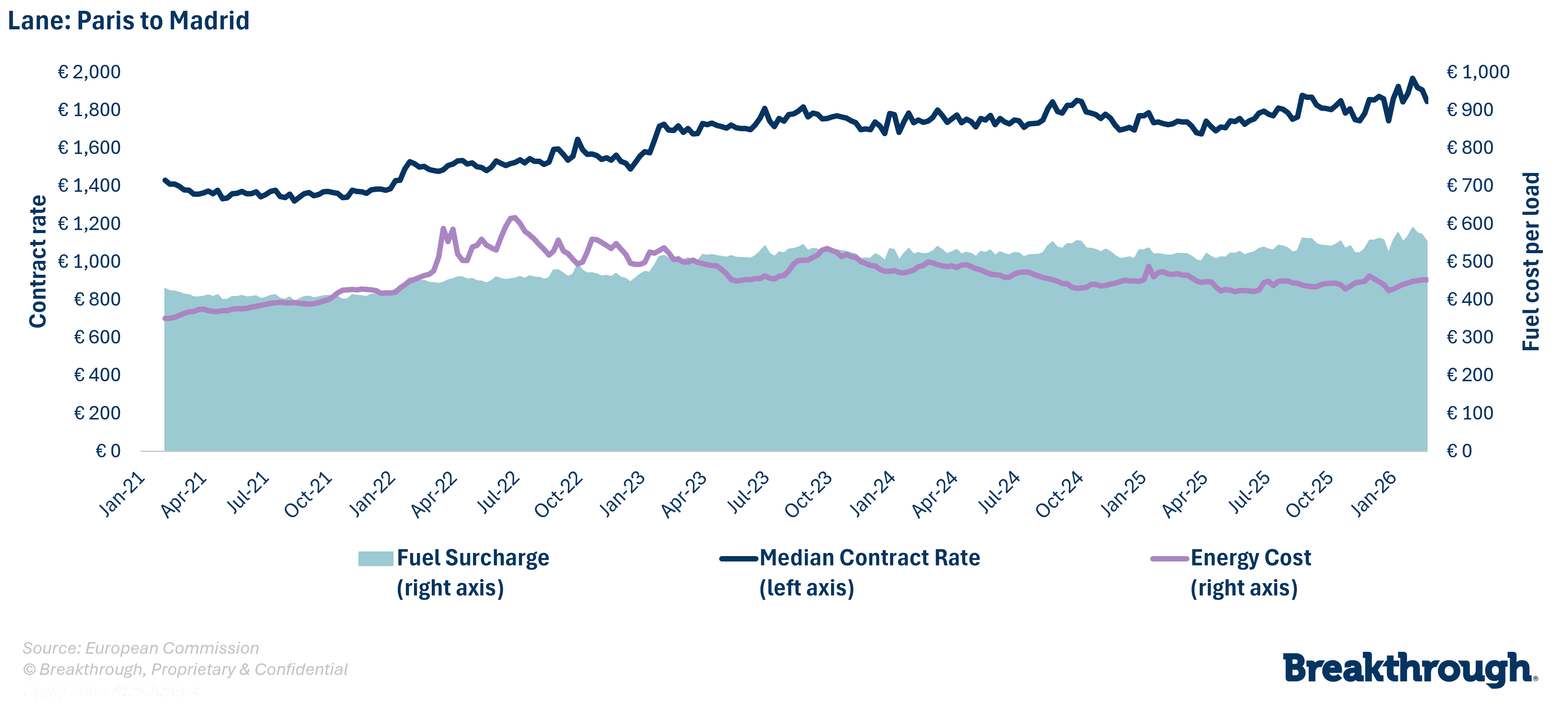
The failure of outdated clauses forces carriers to "reach out to their customers and ask for price adjustments," says Andreas. This initiates an unplanned, time-consuming negotiation process that can erode trust. Shippers may want to wait and see how prices evolve, while carriers cannot afford to. This "ping pong" effect creates an administrative burden and can damage the foundation of a strategic partnership, turning it into a transactional and often adversarial relationship.
The most effective way to manage this volatility is to unbundle fuel from transport costs. Breakthrough’s Fuel Recovery solution in Europe is designed to do exactly that. By separating these two distinct costs, you can address fuel with the precision it requires.
Our program uses a market-based approach that calculates fair and accurate reimbursements based on five key components:
Price: Using real-time data to reflect current market prices.
Tax: Accounting for variations in fuel taxes by country.
Time: Paying the accurate price from the day of the shipment with weekly adjustments.
Equipment: Recognizing how different equipment types influence fuel consumption.
Fuel Efficiency: Factoring in freight weight, fleet age, and geography.
This approach moves away from flawed averages and ensures your transport partners are paid fairly for the fuel they consume.
The current volatility in the energy market, intensified by events like the Iran War, has exposed the weaknesses of traditional transport charge models. Relying on slow-moving monthly or quarterly adjustments puts immense financial pressure on carriers and creates friction in shipper-carrier relationships.
By implementing a solution like Fuel Recovery, shippers can create a fair, transparent, and accurate system for managing transport costs. This data-driven approach not only stabilizes budgets but also fosters stronger, more resilient partnerships with carriers who are essential to your supply chain.
Fuel Recovery separates the cost of fuel from your transport rates. It calculates a fair and accurate reimbursement for each shipment based on weekly market prices, country-specific taxes, and the actual energy consumption of the movement. This ensures you only pay for the fuel that is consumed, protecting your budget from the distortion of all-in rates.
Traditional diesel clauses typically adjust on a monthly or quarterly basis. During periods of rapid price increases, this creates a significant lag. Carriers are forced to pay today’s high prices at the pump but are only compensated based on an average from previous weeks or months, which can lead to substantial financial losses and threaten their operational viability.
Fuel Recovery in Europe provides weekly price adjustments. This frequency ensures that reimbursements align closely with real-time market conditions, offering a much more fair and accurate payment to carriers compared to slower monthly or quarterly diesel clauses.
Yes. Bundling fuel and freight costs often hides inefficiencies. For example, shippers may continue paying high transport rates even when fuel prices decrease because the costs are not managed independently. By unbundling fuel and freight, you gain visibility into your true energy consumption and can ensure you are not over-reimbursing for fuel when market prices fall.
Fuel Recovery
See how Fuel Recovery in Europe enhances transport hauler partnerships in volatile energy markets.

21 min read
October 21, 2026
Track the Iran War's impact on energy markets. Use our weekly update to protect your transportation budget. Read the latest today.
Read more
12 min read
October 6, 2026
The October 5 executive order defers federal tax on dyed diesel used on-highway through December 31, 2026. Learn what it changes, what it does not, and how it affects fleet fuel programs.
Read more
3 min read
August 12, 2026
Visit Breakthrough at booth 302 during CSCMP EDGE and hear Andersen Corporation share how data-driven insights help manage fuel volatility and rising costs.
Read more