
6 min read
March 27, 2026
Iran War: Energy Market Impact Tracker
Track the Iran War's impact on energy markets. Use our daily update and real-time insights to protect your transportation budget. Read the latest today.
Read more6 min read
February 12, 2026

Share:
Table of contents
Browse the table of contents to jump straight to the part you’re looking for
Are you looking for ways to reduce your transportation spend? Many shippers focus on negotiating linehaul rates and managing accessorial charges, but often overlook a critical detail: fleet fuel efficiency. An inaccurate miles-per-gallon (MPG) calculation can lead to millions of dollars in overpayments each year. This miscalculation not only inflates your transportation budget, but your network's carbon emissions as well.
The key is to move beyond outdated Class 8 fuel efficiency metrics and ensure carriers are reimbursed according to their actual operational performance. By adopting accurate fuel efficiency benchmarks, you can significantly reduce fuel spend and enhance transparency across your network. Improved fuel efficiency directly translates to reduced consumption, allowing you to achieve measurable progress toward your sustainability goals.
Inaccurate MPG data leads to significant overspending. Relying on outdated MPG figures for fuel reimbursements means you are likely overpaying carriers and hurting your bottom line.
Fleets are rapidly advancing. New trucks are built with advancements that raise fuel efficiency metrics. Your fuel reimbursement strategy should reflect these improvements.
Industry benchmarks are essential. Analyzing relevant fleet fuel efficiency benchmarks from a trusted source, like Breakthrough or the North American Council for Freight Efficiency (NACFE), allows you to set fair and accurate fuel efficiency metrics.
Improved fleet fuel efficiency supports sustainability goals. Reducing fuel consumption directly lowers your transportation emissions, providing a clear path to make progress toward your corporate sustainability goals.
Many shippers use fuel efficiencies between 6.0 and 8.5 MPG in their fuel surcharge schedules. Currently, the Breakthrough average truckload fuel efficiency is 6.7 MPG; however, our data of over 46.5 million shipments shows a maximum MPG of 7.8 or higher in every industry. If your MPG benchmark hasn't been updated recently, you are likely over-reimbursing for fuel.
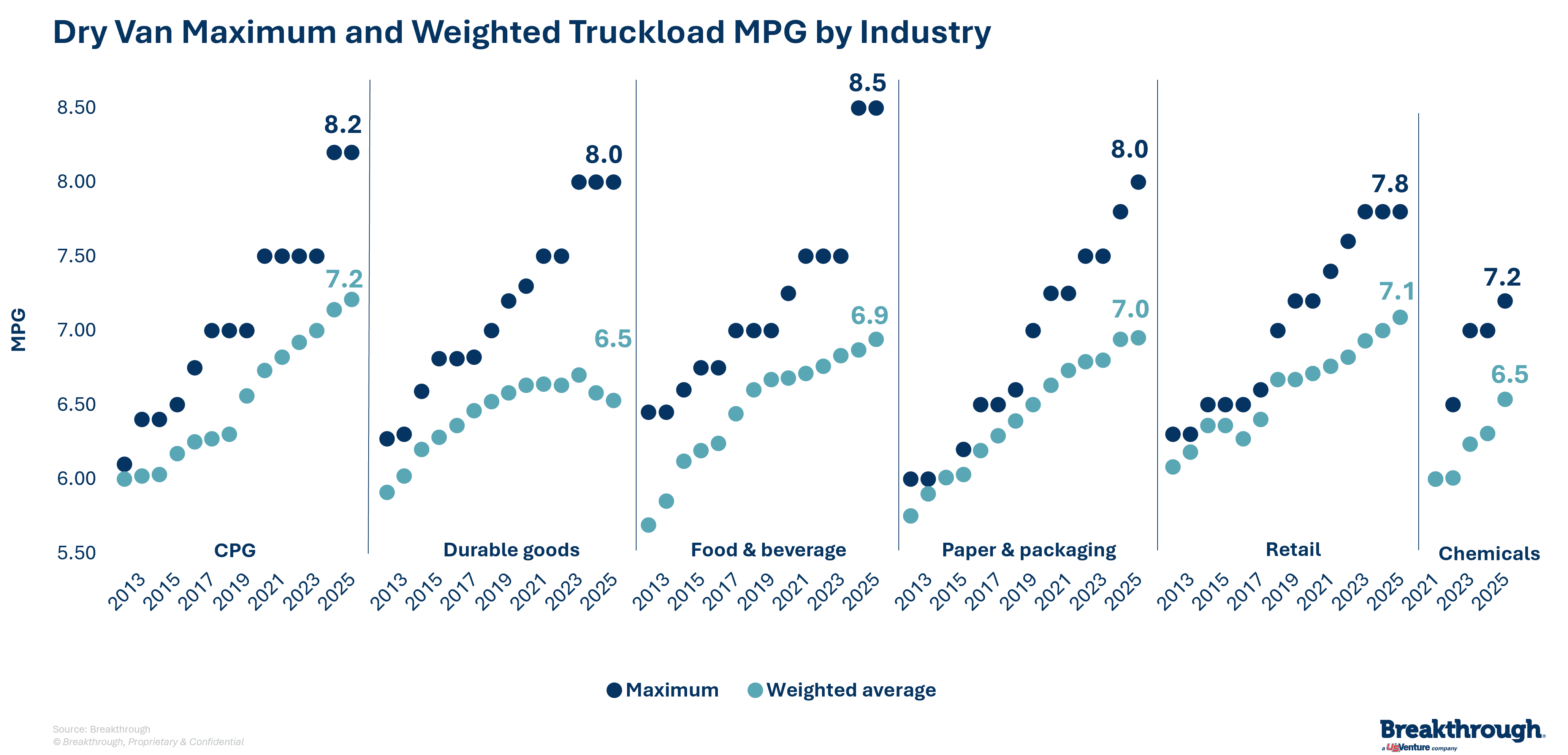
Begin by analyzing your industry's fleet fuel efficiency benchmarks against your own, considering the unique needs of your transportation network. This allows you to have more data-driven conversations with carriers and answer tough questions from your C-suite about your cost-reduction strategies. A market-based fuel reimbursement program provides the network visibility needed to establish this baseline and reimburse carriers a fair and accurate fuel price.
Every year, new technology is released that is specifically designed to make trucks more efficient. Below are some of the most effective fuel efficiency technologies that are prevalent in fleets today:
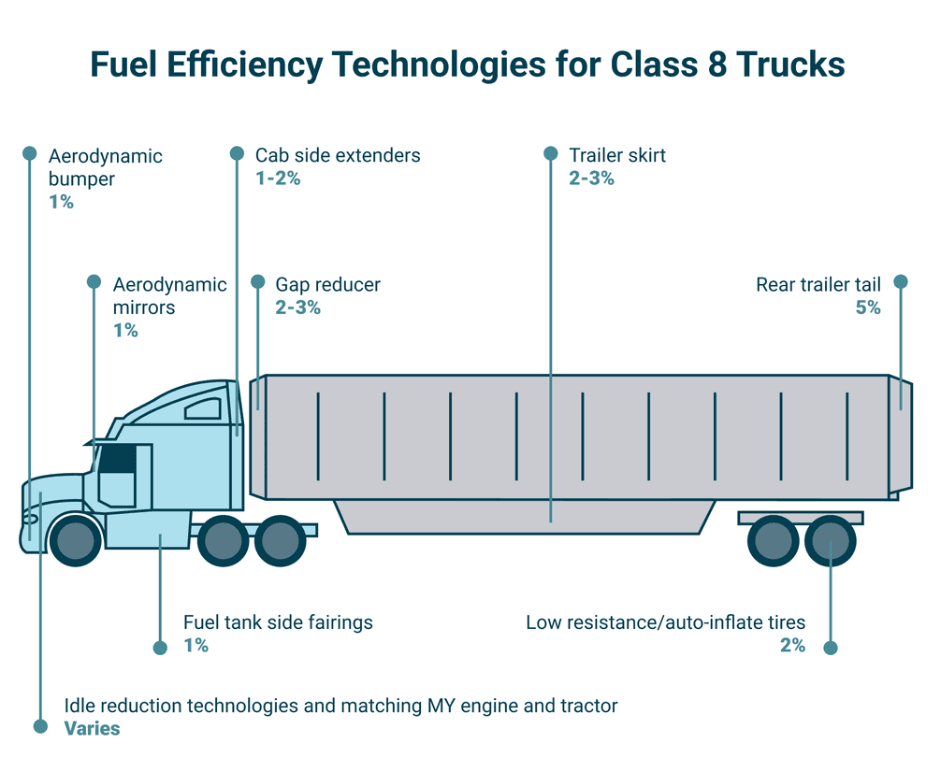
Additionally, highly capable drivers and increased automation influence the use and effectiveness of new technology. Programs like the EPA’s SmartWay and NACFE are sharing research that improving fleet fuel efficiency goes beyond just adopting more efficient vehicles.
Not all carriers are the same. Data from the FMCSA shows that large and mega-carriers invest more heavily in new equipment, resulting in more fuel-efficient fleets. Averaging fuel efficiency across all carriers in your network can obscure these differences and lead to inaccurate reimbursements.
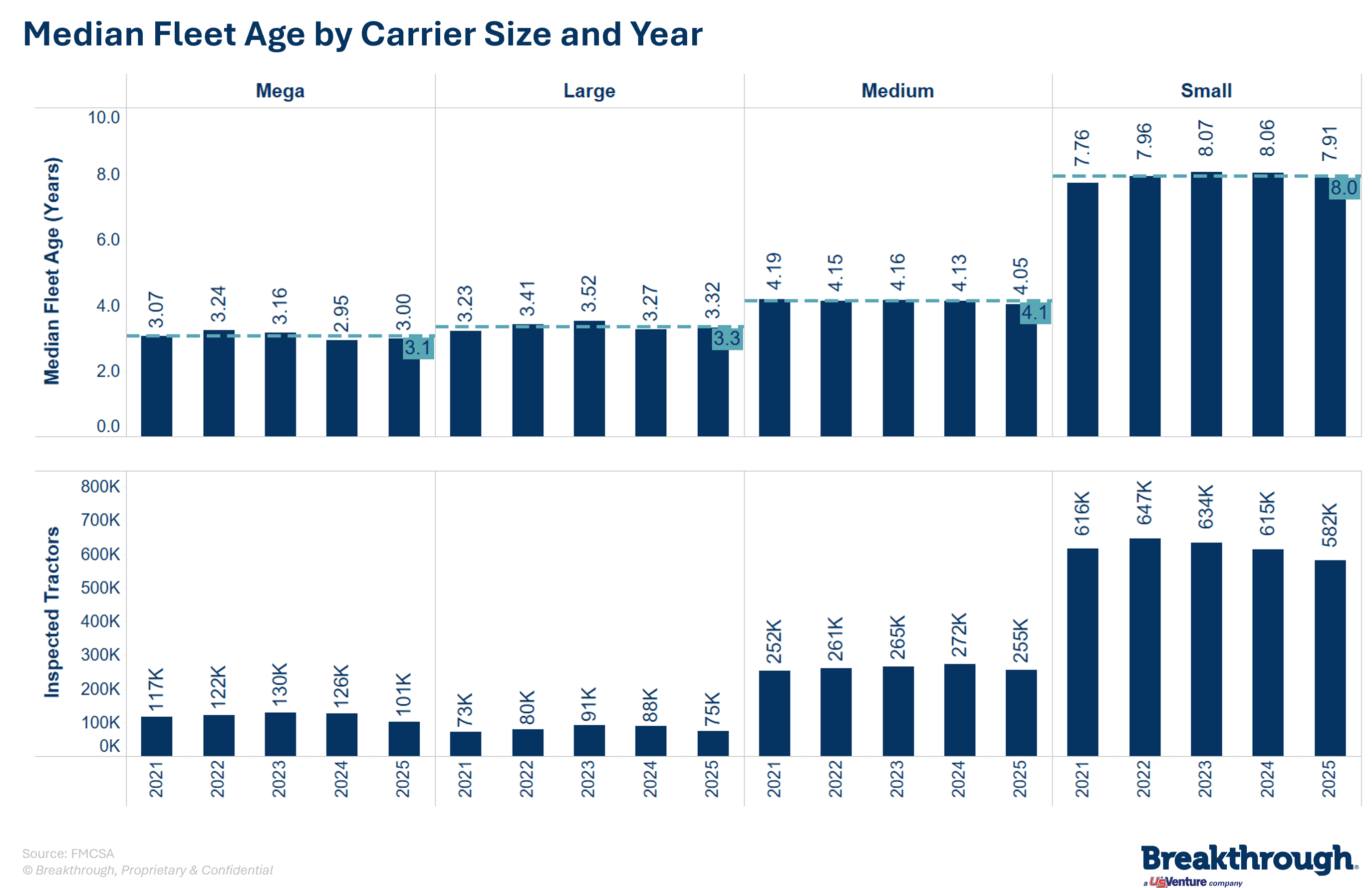
Instead, look at the specific carriers moving your freight. As one transportation director noted after implementing Fuel Recovery, fleet fuel efficiency visibility provides "a better leverage point when you are negotiating contracts with your carriers." Using this data enables you to engage in data-driven procurement discussions with your carriers.
Even a minor adjustment to your MPG calculation can yield substantial cost avoidance. Consider a shipment traveling 818 miles from Milwaukee to Atlanta. A discrepancy of just 0.5 MPG—reimbursing at 6.0 MPG instead of an achievable 6.5 MPG—creates an on-cost of over $20 for that single trip.
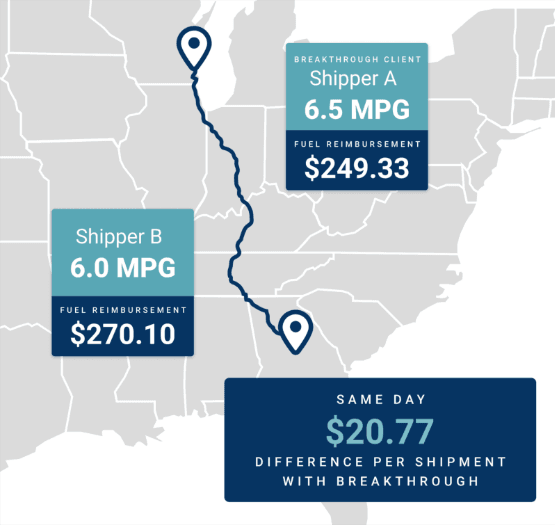
When scaled across a network that spans millions of miles each year, this small inaccuracy adds up to a significant budget overrun. Every tenth of a gallon matters. Using our fuel savings calculator can help you estimate the potential impact of moving to a more accurate, market-based program.
Improving your fleet fuel efficiency is not just about cost savings; it is also one of the most direct ways to advance your sustainability initiatives. By accurately measuring your fuel consumption, you get visibility into the emissions produced by moving your goods to market.
Establishing this accurate baseline is critical. It allows you to calculate your emissions intensity, identify high-impact areas for improvement, and track progress toward net-zero emissions goals. This data also empowers you to create and execute a multi-year roadmap that reduces consumption and emissions.
Managing fleet fuel efficiency is a critical component of a modern transportation strategy. By embracing a data-driven approach, you can uncover significant cost savings and calculate an accurate emissions baseline. Analyzing carrier data, benchmarking your network against industry standards, and understanding the financial impact of small MPG changes will put you in control of your transportation spend and help you achieve your company’s financial and sustainability goals.
Fuel Recovery ensures that your carriers' fuel efficiency is accurately accounted for, enabling you to drive significant cost savings while reducing your environmental impact. Connect with us today to learn how Fuel Recovery can optimize your transportation network.
While many shippers still use benchmarks between 6.0 and 8.5 MPG, this range is often outdated. Breakthrough client data shows an average around 6.7 MPG, and many modern fleets can achieve much higher efficiencies.
Improving fleet fuel efficiency involves a multi-faceted approach. Key strategies include encouraging carriers to adopt fuel-saving aerodynamic products and training drivers on fuel-conscious driving behavior.
A small MPG adjustment can have a massive financial impact when scaled across an entire transportation network. For example, a 0.5 MPG improvement on a single 818-mile trip can save over $20 for a single trip. For a shipper with a large network covering millions of miles, these inaccuracies can add up to millions of dollars in cost avoidance annually.
Fuel Recovery
Uncover the true cost of your transportation fuel spend with market-based data.

6 min read
March 27, 2026
Track the Iran War's impact on energy markets. Use our daily update and real-time insights to protect your transportation budget. Read the latest today.
Read more
3 min read
March 26, 2026
Connect with Breakthrough at Gartner Supply Chain Symposium/Xpo 2026. Visit booth #339 and attend our session with Heineken USA to learn cost-cutting strategies.
Read more
9 min read
March 24, 2026
Learn how market-based fuel management strategies improve transportation cost accuracy, strengthen carrier relationships, and support better fuel management.
Read more