
21 min read
October 21, 2026
Iran War: Energy Market Impact Tracker
Track the Iran War's impact on energy markets. Use our weekly update to protect your transportation budget. Read the latest today.
Read more8 min read
April 24, 2026

Share:
Table of contents
Browse the table of contents to jump straight to the part you’re looking for
In response to the oil market supply shock caused by the ongoing war in the Middle East, governments around the world are intervening to relieve upward price pressure on diesel fuel. These decisions create a complex landscape of varying diesel fuel excise taxes, which cause shippers and carriers to make more strategic decisions to capture temporary market relief.
For transportation leaders, these policy shifts present two very different outcomes. Without visibility, tax changes can increase variability in fuel spend and complicate budgeting. With the right fuel management approach, however, the same disruption can become an opportunity to better align reimbursements with true market conditions and improve network efficiency.
This article outlines how governments are using diesel fuel excise tax policy to manage price pressure and how strategic fuel management and diversification can help shippers and carriers mitigate the impact of fluctuating fuel prices.
The war in the Middle East between the U.S., Israel, and Iran has led to the effective closure of the Strait of Hormuz, a chokepoint for around 20% of global crude oil and refined products. This disruption has caused a supply shock, leading to a marked increase in crude oil prices, refinery margins, and wholesale diesel prices. Uncertainty about safe passage through the Strait of Hormuz, a lack of clarity about the concreteness of diplomatic negotiations, the disconnect between paper and physical fuel market dynamics, as well as the material, structural, and operational impacts on energy infrastructure will likely take months to unwind.
In response, governments around the world are taking steps to lessen the impact on consumers and businesses, while also trying to maintain fiscal stability. Diesel fuel excise tax reductions have emerged as a commonly used lever, as they provide immediate price relief. For companies, these policy shifts can materially change fuel economics by lane.
Governments have deployed a mix of responses to rising fuel prices, including price caps, VAT reductions, oil export controls, and labor policy changes. However, this blog will focus on diesel fuel excise taxes, given their significant impact on fuel prices.
Note: The following examples focus on North America and Europe and are not exhaustive.
Only two states have taken steps to reduce diesel excise taxes.
Takeaway: Strategic refueling opportunities are limited, but regionally concentrated fleets may benefit.
From April 20 to September 7, the Canadian federal government has suspended the 4 cents per liter federal diesel excise tax. However, no Canadian provinces have followed the federal government in reducing or suspending diesel excise taxes thus far.
Takeaway: This provides a general nationwide benefit for shippers and carriers. Few strategic opportunities exist unless provinces implement diesel fuel excise tax reduction measures. Even then, the benefit would only apply to routes heavily concentrated in those provinces or for select inter-provincial routes.
The Mexican government moved quickly to reduce the IEPS diesel tax by nearly 80%. However, more recently, it has been partially rolled back to 43% lower than before the war.
Takeaway: This IEPS tax reduction provides nationwide benefit for shippers and carriers.
More than a dozen countries in the European Union or closely integrated to the EU have adjusted their diesel excise taxes, including Austria, Croatia, Cyprus, Czech Republic, Germany, Hungary, Ireland, Italy, Latvia, Lithuania, Poland, Portugal, Romania, Slovenia, Spain, and Türkiye.
Most EU member countries that have adjusted diesel fuel excise taxes have set the rate at the lowest minimum level permissible by the EU, €0.33/liter diesel. Türkiye, meanwhile, suspended its entire diesel fuel excise tax.
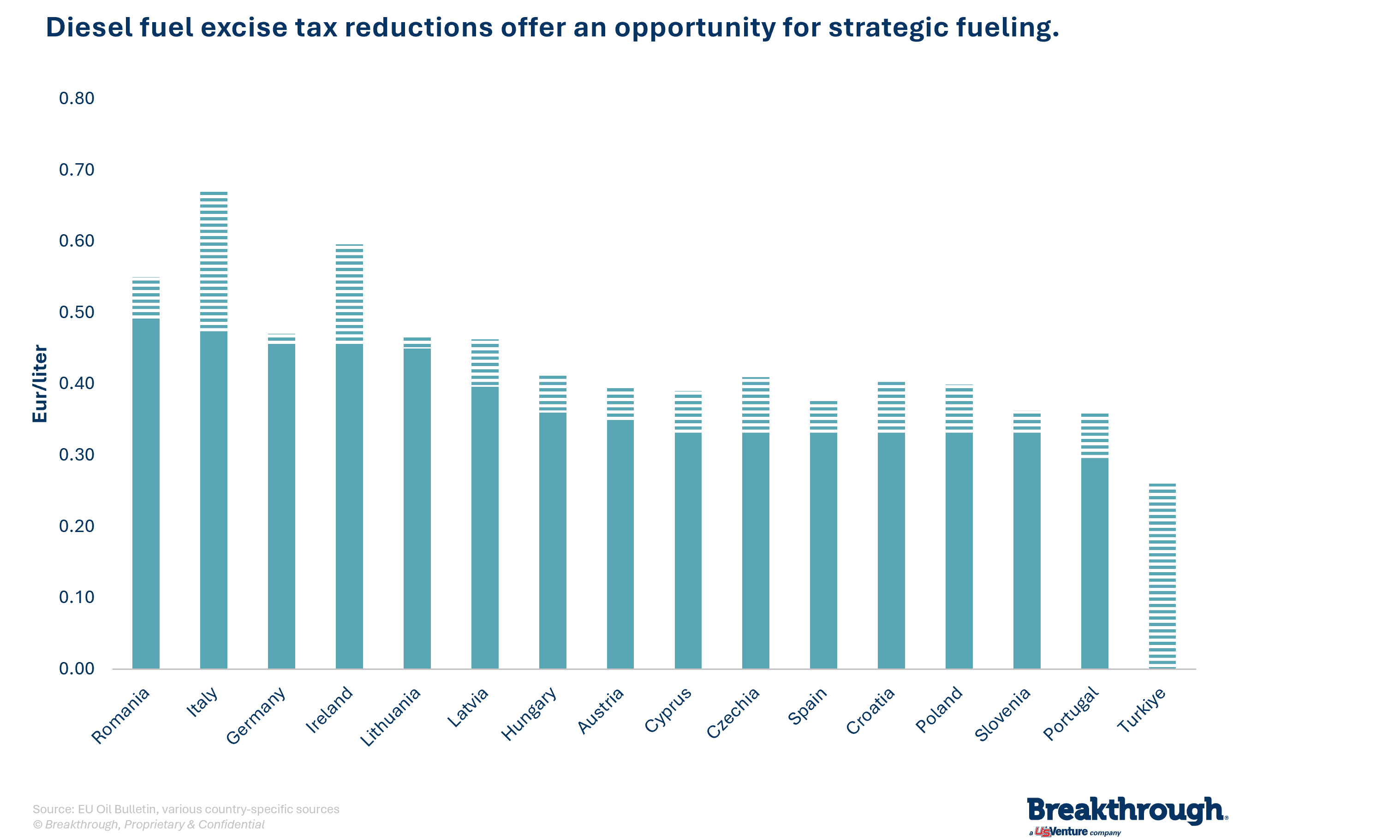
The timelines for these changes vary, but generally, the diesel excise tax reductions will stay in place until June.
Takeaway: Depending on operational feasibility, shippers and carriers should consider adjusting routes to take advantage of select member states’ tax interventions, particularly in Central Europe.
For well-managed shippers and carriers, the range of government interventions in fuel markets may create opportunities for strategic fueling behaviors to help mitigate some of the effects of higher fuel prices. This opportunity will be especially strong in Europe. In practice, this may mean that where operationally feasible, carriers prioritize fueling up in countries that have reduced diesel excise taxes, such as Poland, Czech Republic, Austria, and Hungary. In the medium- to long-term, the war in the Middle East may also provide opportunities for shippers and carriers to consider route optimization, overall network design, prioritize mode shifting (i.e., intermodal), and fuel diversification to improve their economic and operational resilience.
Diesel fuel excise taxes are a significant, and often overlooked, component of the total price of fuel at the pump. These taxes vary dramatically by country, state, or even province, and they can change frequently in response to economic or political events. For shippers and carriers, this tax component directly impacts transportation operating costs.
When taxes are high, fuel expenses rise, squeezing margins and making budget forecasting difficult. Conversely, when governments implement tax reductions or suspensions, it presents a direct opportunity to lower fuel spend. However, capitalizing on these changes requires visibility into when and where they occur. Relying on national average fuel prices or outdated fuel surcharge programs means you likely miss these savings opportunities, as those methods are too broad to capture specific, regional tax adjustments.
Breakthrough’s Fuel Recovery solution replaces average-based fuel surcharge programs with a market-based calculation that reflects the true cost of fuel consumption across your network. Each reimbursement incorporates:
When a government reduces, increases, or suspends a diesel fuel excise tax, those changes are immediately reflected in Fuel Recovery calculations without manual intervention. This ensures shippers neither overpay during relief periods nor lose visibility when taxes return.
Geopolitical instability and resulting government interventions have made the fuel market more complex. Relying on traditional fuel surcharge programs leaves your organization vulnerable to overspending. By adopting a market-based approach with Breakthrough’s Fuel Recovery solution, you gain the clarity and accuracy needed to navigate this volatility.
Take control of your fuel costs and gain lane-level insight into the market. Discover how Breakthrough’s Fuel Recovery solution can deliver measurable results for your organization.
A diesel fuel excise tax is a government-imposed levy on diesel fuel, typically assessed per gallon or liter. Rates vary by country, state, or province and are often adjusted in response to economic or geopolitical conditions.
The conflict has disrupted global oil supply routes, increasing fuel prices. Temporarily lowering diesel fuel excise tax helps governments provide immediate relief to businesses and consumers without directly setting fuel prices.
Tax changes can materially alter fuel costs on specific lanes. Without lane-level visibility, organizations may miss savings opportunities or misalign reimbursements with actual costs.
Market-based fuel programs like Fuel Recovery automatically reflect tax changes by time and geography, enabling accurate reimbursement without manual tracking.
Fuel Recovery
Account for daily market and tax changes with Fuel Recovery.

21 min read
October 21, 2026
Track the Iran War's impact on energy markets. Use our weekly update to protect your transportation budget. Read the latest today.
Read more
12 min read
October 6, 2026
The October 5 executive order defers federal tax on dyed diesel used on-highway through December 31, 2026. Learn what it changes, what it does not, and how it affects fleet fuel programs.
Read more
3 min read
August 12, 2026
Visit Breakthrough at booth 302 during CSCMP EDGE and hear Andersen Corporation share how data-driven insights help manage fuel volatility and rising costs.
Read more