5 min read
Market-Based Fuel Reimbursements Tip Sheet
January 1, 2025
Share:
Table of contents
Browse the table of contents to jump straight to the part you’re looking for
Executive Summary
In recent years, shippers have grappled with unpredictable surges in fuel prices, resulting in significant impacts on their transportation budgets.
While transportation teams can’t prevent market volatility, there’s a proven way to take the sting out of future fuel price surges: market-based fuel reimbursements. A market-based fuel reimbursements program ensures the amount you reimburse your carriers for fuel is based on real-time, lane-level price movements — a fairer and more accurate calculation for both you and your carrier partners.
But the benefits go beyond the bottom line. With Fuel Recovery, Breakthrough’s market-based fuel reimbursement rate solution, shippers often achieve a 10X ROI in the first three months while gathering data that enables progress toward high-level goals like reducing scope 1 and 3 transportation emissions and improving network performance.
So, when C-suite stakeholders ask tough questions, you’ll be ready with answers.
How Market-Based Fuel Reimbursements Work and Why They Save You Money
Fuel surcharges based on national average fuel prices from the Department of Energy (DOE) cause shippers to reimburse carriers at a distorted price point.
For example, diesel costs are considerably greater in Pennsylvania, with its high fuel tax rate, than in states like Texas and Oklahoma. A shipper with a lane from Dallas to Pittsburgh might assume the average price along the lane aligns to the DOE’s weekly retail average. However, as you can see, relying on the DOE index results in inaccurate reimbursements.
Market-based fuel reimbursements ensure price transparency by aligning payments to the actual market fuel prices along a shipment’s route.
Unlike the DOE, market-based fuel reimbursements account for:
Key Insight:As a result of using market-based fuel reimbursements, you can compensate carriers fairly and reduce your truckload fuel spend by 20% on average. | 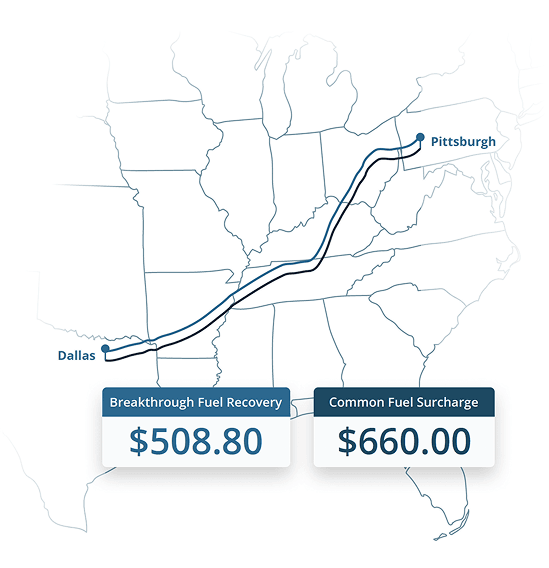 |
3 Benefits of Market-Based Fuel Reimbursements Beyond Cost Savings
Access to lane-level data doesn’t just ensure a fair and accurate fuel reimbursement. It also surfaces actions that allow you to make meaningful progress toward high-level business objectives — and measure progress along the way. Plus, with visibility into fuel consumption and emissions tracking on each of your lanes, it’s easy to elevate success stories and opportunities to stakeholders.
1. Measure Sustainability Progress
Fuel Recovery captures your precise fuel consumption by lane to calculate market-based fuel reimbursements. The same data enables you to accurately record your scope 3 transportation emissions output.
With accurate fuel consumption data, you can:
- Set realistic, measurable emissions reduction goals and track progress toward them.
- Develop targeted carrier, mode, and energy selection strategies to optimize fuel efficiency.
- Demonstrate sustainability commitments and progress to stakeholders and customers.
2. Make Continuous Improvements
Fuel Recovery clearly separates fuel spend from freight spend, providing a more granular view of how your budget is being used. This increased visibility makes it possible to identify opportunities for lane-level improvements that would otherwise remain hidden.
Examples include the ability to:
- Increase miles-per-gallon efficiency based on your industry.
- Implement a zero-base rate strategy so you’re accurately compensating carriers.
- Identify carriers best-suited to your lanes based on network priorities.
3. Evaluate Transportation Performance
Using market-based fuel reimbursements powered by Fuel Recovery equips you with a clean, accurate dataset that can be used to track transportation network performance. With access to a more comprehensive view of how your network is performing to plan, it becomes easier to communicate wins, opportunities, and progress toward goals to senior leadership.
You can reliably track key KPIs like:
- Fuel consumption and miles-per-gallon.
- Fuel spend vs. linehaul spend.
- Carrier performance and rate vs. benchmark.
Save Money and Showcase Wins with Fuel Recovery
You can’t prevent diesel market price swings, but you can regain control over your fuel spend while making continuous, cost-saving improvements throughout your transportation network. Market-based fuel reimbursements are a key component of a resilient transportation energy budget and a mechanism for achieving high-level goals, even during periods of economic turbulence.
Ready to bring clarity to your fuel budget?
Learn how Breakthrough’s Fuel Recovery program can help mitigate budget uncertainty with market-based fuel reimbursements tailored to your network.

Download the tip sheet
Take the full Mitigate Budget Uncertainty with Market-Based Fuel Reimbursements tip sheet with you. Download your copy to save these insights for future reference or to share them with your team.