5 min read
2024 Decarbonization Report
May 1, 2024
Share:
Table of contents
Browse the table of contents to jump straight to the part you’re looking for
- Introduction
- Executive Summary
- Key Takeaways
- Section 1: Significant developments in decarbonization will shape the transportation sector in 2024
- Section 2: Create synergistic shipper and carrier partnerships to achieve science-based targets
- Section 3: A proven path forward for shippers to meet carbon reduction targets
Introduction
In recent years, sustainability emerged as a significant focus for shippers. With increasing pressure from governments, peers, and consumers, progress towards science-based targets in 2024 will be crucial. Stay informed about the latest advancements and strategies to implement in the upcoming year.
Executive Summary
As the transportation sector continues to face mounting pressure to combat climate change, effective communication and collaboration between shippers and carriers play a pivotal role in achieving science based targets. By incorporating specific requests in the RFP process, partnering with transportation emission management technology providers, and adopting the Global Logistics Emissions Council (GLEC) framework, shippers can accurately track and report their emissions and take targeted actions to reduce their carbon footprint. These efforts will contribute to a more sustainable future and position shippers as leaders in mitigating climate change, while also retaining their competitive advantage.
Key Takeaways
- Set transportation emissions reduction targets
- Find emissions hot-spots in your transportation network
- Evaluate decarbonization options and quantify opportunities
- Implement solutions
- Monitor KPIs to track success
Explore the 2025 Decarbonization Report
Check out the 2026 Decarbonization Report for the most up-to-date trends and insights.
Section 1: Significant developments in decarbonization will shape the transportation sector in 2024
The transportation industry stands as one of the largest contributors to global greenhouse gas emissions, making it a crucial focal point for combating climate change. As a result, companies face mounting pressure from various stakeholders, including governments, peers, and consumers, to proactively address decarbonization. The shift to a more sustainable transportation sector presents both challenges and opportunities for businesses striving to remain competitive while also embracing a greener future.
Government pressure
One of the main drivers for these changes is the increasing focus on sustainability and reducing carbon emissions. Governments around the world are implementing stricter regulations and policies aimed at mitigating climate change, which include measures targeting transportation emissions. This will place pressure on companies to find ways to reduce their carbon footprint to meet these requirements and avoid penalties.
Under the Infrastructure Investment and Jobs Act (IIJA), Congress has allocated over $590.7 billion to transportation, with a particular focus on transportation infrastructure. The goal is to promote modernization and reduce emissions across all modes of transportation.
Clean Energy Infrastructure |  | US Department of Energy Explore awarded or currently available funding opportunities |
Inflation Reduction Act Tracker | | Columbia University and the Environmental Defense Fund Explore awarded or currently available IRA funding opportunities |
| To address environmental concerns, the Environmental Protection Agency (EPA) is actively working on phase 3 of heavy-duty emissions standards. These standards begin for the model year 2027 with the effects forecasted to extend until 2055. The EPA projects these standards could prevent nearly 1 O billion tons of CO2 emissions across light-, medium-, and heavy-duty vehicles. This reduction is equivalent to more than twice the total U.S. CO2 emissions in 2022. In addition, the EPA is currently assessing emissions standards for power plants and actively seeking ways to encourage the generation of clean energy. These initiatives will not only enhance the environmental advantages of electric vehicles but also play a significant role in shaping a greener energy landscape for the future. | 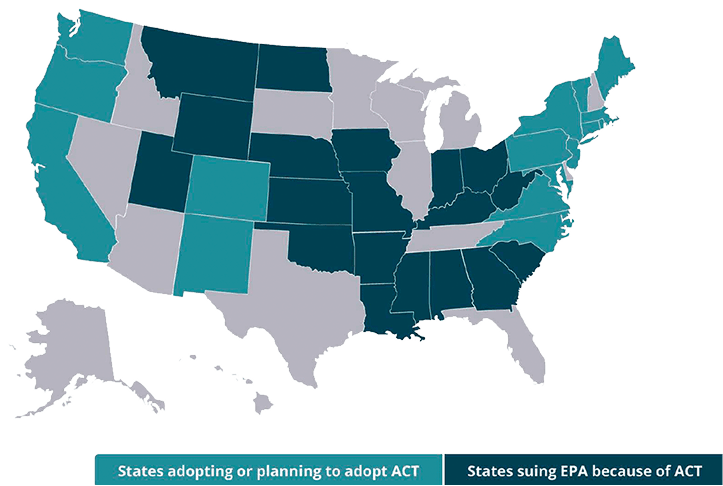 |
States and local governments are taking proactive steps to reduce their carbon footprint. An excellent example is California's Advanced Clean Trucks (ACT) initiative, which mandates that by 2035, 75% of all medium and heavy-duty truck sales (class 4-8) in the state must be zero-emissions, with 40% falling under class 7-8. Several states have adopted this rule including Rhode Island, Colorado, Massachusetts, New Jersey, New York, Oregon, Vermont and Washington. Moreover, Connecticut, Maryland, Maine, North Carolina, Pennsylvania, and Virginia have shown their commitment to adopting California's truck emission standards by signing a memorandum of understanding. However, it is important to note that not all states are supportive of ACT, with some even filing lawsuits against the EPA.
| On April 28, 2023, the California Air Resources Board (CARB) passed the Advanced Clean Fleets (ACF) rule, which serves as a powerful complement to ACT. ACF requires large carriers to revamp their fleets, requiring drayage trucks to transition to zero-emission vehicles (ZEVs) starting in 2024. The transition must be fully implemented by 2035, except for work trucks and day cab tractors, which have until 2039, and sleeper cab tractors and specialty vehicles, which have until 2042, if the ultimate purchaser is in California. Additionally, ACF aims to eliminate diesel truck sales by 2036, fostering the accelerated adoption of ZEV medium and heavyduty vehicles. CARB estimates that by 2035, ACF and ACT combined will result in 510,000 ZEVs in California, with figures projected to reach 1.35 million by 2045 and 1.69 million by 2050, including Class 2b-8 trucks. Similar to ACT, ACF is also facing lawsuits. These two regulations will play a pivotal role in helping California achieve Governor Gavin Newsom's goal of fully transitioning the trucks that travel across the state to be ZEVs by 2045. | 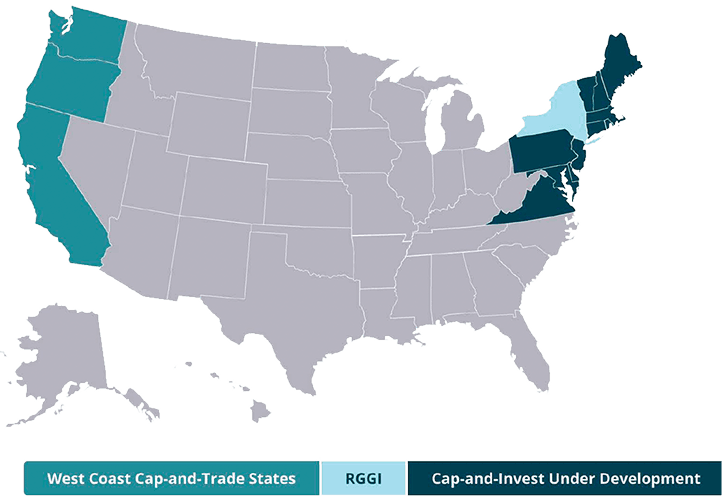 |
The cap-and-trade system continues to be one of the most popular mechanisms for putting a price on carbon. Under this system, the state sets a cap on emissions and issues permits known as ''allowances," equivalent to the permitted emissions. Entities subject to the program must hold enough allowances to cover their emissions. They can buy or sell these allowances on the market, with prices reflecting supply and demand. As emissions decrease, the government steadily lowers the cap, forcing covered entities to decrease their emissions or buy more allowances, ultimately resulting in a reduction in carbon emissions. Cap-and-trade systems are active in California, Oregon, and Washington, most of the upper East Coast through the Regional Greenhouse Gas Initiative (RGGI), and soon, a new cap-and-invest program in New York.
In more recent news, California passed Senate Bill 253, also known as the Climate Corporate Data Accountability Act. This legislation requires both public and private US businesses operating in California and generating revenues exceeding $1 billion to report their scopes 1 and 2 in 2026 and scope 3 emissions in 2027.
In light of the ongoing gridlock in Congress, many states are taking the lead in tackling climate change. California has been at the forefront of the emissions reduction movement, and now New York, Washington, and Oregon are following suit, demonstrating a growing trend among states to take action on this critical issue. As state-level efforts continue to gain momentum, it is becoming increasingly clear that action on climate change will not wait for federal action, and that bold, innovative solutions will be required to protect our planet for future generations.
Peer pressure
Companies are also facing increasing pressure from their peers who have already set science-based targets and are proactively taking steps toward meeting emissions targets. A recent survey of Breakthrough clients shows that nearly two-thirds have set up emissions reduction objectives, with one in every four consciously working toward decarbonizing transportation. While reducing scope 3 emissions poses a significant logistical challenge, a trusted transportation management provider can streamline the collection and organization process, as well as offer recommendations to help achieve these goals.
Consumer pressure
Ultimately, it is consumer demand that will determine whether companies are meeting the mark in winning their business. The impact of this is felt by transportation leaders as well. As highlighted in Breakthrough's 2023 State of Transportation Report, a staggering 94% of these leaders acknowledge that the demand for sustainable products from consumers makes emission reduction an even more crucial priority in the coming year. As such, companies must prioritize decarbonization efforts in order to remain competitive and meet the demands of consumers while also following regulatory requirements.
These developments suggest there is a significant shift towards decarbonization in the transportation sector, with the trend expected to gain speed in 2024. The key to staying ahead of the curve is through collaboration and partnerships with trusted transportation management providers who can help navigate the complex landscape of decarbonization. As we move towards a greener future, it is imperative for companies to prioritize decarbonization efforts in order to remain competitive.
Section 2: Create synergistic shipper and carrier partnerships to achieve science-based targets
Effective communication between shippers and carriers plays a pivotal role in achieving science-based targets. By clearly communicating and sharing data, they can make significant progress in reducing emissions. Shippers can initiate this process by incorporating specific requests in the RFP, such as the carrier's emissions reduction targets, ownership of alternative energy trucks, and their SmartWay score. By doing so, shippers convey a strong message that they are actively seeking ways to decarbonize. This can also serve as a starting point for shippers and carriers to explore potential pilot programs for further emission reduction. However, the process of collecting this data is just the beginning. It requires a significant amount of time from team members' already busy schedules. To achieve substantial reductions in emissions, shippers must take an approach that fits within their budget and time constraints. By partnering with a technology provider specializing in transportation emissions management, shippers have real-time visibility of their total lifecycle emissions and can consider recommendations at the lane level. This approach ensures that shippers will meet their targets while avoiding the pitfalls of greenwashing, which can have a detrimental impact on a shipper's reputation. The statistic here highlights the need for comprehensive and data-driven solutions in transportation emissions management. Equipped with robust data and actionable recommendations, shippers can now embark on the next phase of their journey: reducing transportation emissions. | ![“Ninety-three percent of Global 2000 companies with net-zero [carbon emission] commitments say they will miss targets based on their current trajectory.” Source: Accenture Report: How do we turn net-zero commitments into reality?](https://big-comfort-7ce80fc531.media.strapiapp.com/2024_decarb_img_3_11b9037e19.png) |
Here are three of the most effective strategies to manage the transition toward new synergistic shipper and carrier partnerships:
1. SmartWay
The SmartWay program, administered by the EPA, is specifically designed to assist shippers, carriers, and other stakeholders in reducing their carbon footprint. Through carrier participation in this program, shippers can effectively identify carriers with low carbon emissions and those with room for improvement. Thus, educating carriers about the program and encouraging their involvement has become a top priority for shippers. Currently, there are over 400,000 registered carriers in the U.S., but only 4,000 of them are part of the SmartWay EPA program. To bridge this gap, shippers actively invite SmartWay representatives to their meetings with carriers to discuss the program's benefits and application process.
Just 1% of registered U.S. carriers are part of the SmartWay EPA program.
It is worth noting that even a one-rank improvement in a carrier's SmartWay score can result in a significant 6% reduction in emissions per shipment. In fact, moving from an unranked status to rank 5 can achieve cumulative emissions reductions of over 30%. By establishing strong partnerships with carriers, shippers can demonstrate their commitment to achieving science-based targets and advancing their sustainability efforts.
2. PIlot programs
Shippers and carriers can benefit immensely by collaborating on a pilot program to trial alternative energy-powered tractors. If proven successful, the alternative energy-powered tractor would reduce the carriers' scope 1 emissions and the shippers' scope 3 emissions. To have the numbers make sense for both the shipper and carrier, a multiyear contract can provide the necessary stability and investment needed for carriers to make the switch to alternative energy. By partnering on a pilot program, shippers and carriers can lead the way in building a more sustainable future for the transportation industry.
Trucks equipped with alternative energy sources, such as RNG and electric power, have undergone extensive development and are now ready for comprehensive testing to meet the freight demands of shippers. Knight Transportation has been actively conducting field tests in California on Cummins' X1 SN natural gas powertrain, with ongoing testing scheduled until 2024. The ultimate objective is to achieve a 50% reduction in CO2 emissions by 2035. In addition, the market has shown interest in Freightliner's eCascadias. Frito-Lay, in partnership with Schneider and Freightliner, anticipate an emissions reduction of over 70% compared to traditional diesel trucks for their initial battery electric vehicle (BEV) routes. BEVs are still in the process of substantiating their claims, which is why they are currently limited to short-haul and dray routes.
3. MPG fuel efficiency improvements
Advancements in technology have led to continuous improvements in fuel efficiency for fleets. According to Breakthrough data, diesel trucks have been experiencing an annual increase in fuel efficiency of around 3-4%. In 2023, the average fleet MPG fuel efficiency was an impressive 7.68, a significant improvement compared to previous decades.
When engaging in MPG efficiency improvement discussions with carriers, it is crucial to have access to benchmarks and take into account factors such as shipment weight, route, and the carrier's average fleet age. It is equally important to establish a mutually beneficial agreement that considers the interests of both the shipper and the carrier. This approach helps mitigate any potential service issues that may arise from an imbalanced agreement.
In conclusion, effective communication and collaboration between shippers and carriers play a vital role in achieving science-based targets for reducing transportation emissions. By incorporating specific requests in the RFP process, partnering with transportation emission management technology providers, encouraging participation in the SmartWay program, and exploring pilot programs for alternative energy-powered trucks, shippers can make significant strides towards their sustainability goals. This collaborative effort will not only contribute to a more sustainable future but also position shippers and carriers as leaders in mitigating climate change.
Section 3: A proven path forward for shippers to meet carbon reduction targets
Shippers are actively seeking ways to reduce carbon emissions in response to government regulations, peer pressure, and consumer demands. A proven path forward is through the adoption of a transportation emissions management technology that is accredited and aligns with the Global Logistics Emissions Council (GLEC) framework. By relying on this framework, shippers can accurately calculate their emissions in accordance with the CDP disclosure system and the GHG Protocol corporate carbon accounting standard. This comprehensive framework not only provides a clear method for emissions calculation but also empowers shippers to take precise and targeted actions to reduce their environmental impact.
Once shippers have a trusted emissions baseline, they can consider four highly effective methods to minimize transportation emissions.
 | Explore alternative energy infrastructure within your transportation network |
 | Select carriers with low to zero carbon emissions |
 | Optimize lanes by mode |
 | Evaluate networks and payloads for efficiency opportunities |
The implementation of multi-tiered strategies presents significant opportunities for positive and sustainable change, leading to nearly $1.2 billion in fuel and freight savings and 2 billion kgCO2e reduction annually within the Breakthrough ecosystem. Mode optimization can reduce emissions by 50% to 70% and reduce total cost by 5% to 25% per lane, while optimizing unused capacity can provide a 12% emissions reduction.
Significantly reduce emissions and cost through mode optimization
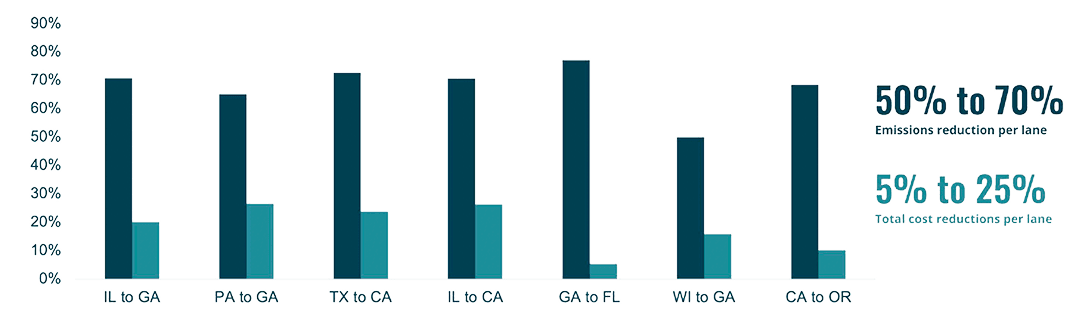
While some may resist change, it is important to communicate the benefits of decarbonization and the urgency of the situation. The implementation of multitiered strategies not only presents opportunities for positive and sustainable change, but can also lead to significant emissions reduction and cost savings. The Breakthrough ecosystem of shippers stands to achieve nearly $1.2 billion in fuel and freight savings and 2 billion kgC02e reduction through the implementation of transportation decarbonization strategies.
On a larger scale, the United States' 5th National Climate Assessment report stated the impacts of a decarbonized transportation sector, ''A carbon-free, sustainable, and resilient transportation system would have societal benefits beyond reduced climate change impacts, potentially leading to improvements in air quality, physical fitness, incidence of cardiovascular and respiratory disease, mental health, crash rates, noise pollution, social equity, ecosystems, biodiversity conservation, energy independence, and the economy. When these co-benefits are considered, the benefits of GHG mitigation actions in the transportation sector far outweigh the costs." Using the GLEC framework and targeted emissions reduction strategies, shippers can play a critical role in creating a more sustainable future.
Ready to build a resilient, sustainable transportation network?
Request a demo to discover the hidden opportunities to optimize your transportation operations for peak efficiency, sustainability, and reliability — and set the standard in your industry.

Download the report
Take the full 2024 Transportation Decarbonization Trends report with you. Download your copy to save these insights for future reference or to share them with your team.