
6 min read
March 27, 2026
Iran War: Energy Market Impact Tracker
Track the Iran War's impact on energy markets. Use our daily update and real-time insights to protect your transportation budget. Read the latest today.
Read more7 min read
December 1, 2025

Share:
Table of contents
Browse the table of contents to jump straight to the part you’re looking for
Are volatile fuel prices and outdated surcharge programs eroding your transportation budget? For many shippers, fuel is the second largest and most unpredictable component of their transportation spend, yet it often goes largely unmanaged. Relying on national averages leaves money on the table and impedes sustainability efforts. The solution is a strategic, data-driven approach that provides transparency and control over your true fuel costs.
This guide outlines six core strategies for effective transportation fuel cost reduction. You will learn how to move beyond averages, optimize your network, and leverage data to build a more resilient and efficient supply chain.
Adopt market-based fuel reimbursement: Replace inaccurate, index-based fuel surcharges with a market-based program like Fuel Recovery to pay the actual price of fuel for each freight movement. On average, you could save 20% on truckload shipments.
Prioritize network efficiency: Reduce fuel consumption by optimizing routes, minimizing empty miles, and improving truckload fuel efficiency (MPG) through data-driven network design and carrier collaboration.
Evaluate intermodal conversion: Convert freight from truckload to intermodal can significantly cut both fuel costs and transportation emissions, offering a powerful lever for networks where transit time is flexible.
Develop a holistic strategy: The most effective approach combines multiple levers—from fuel reimbursement to network optimization and alternative energies—to create a comprehensive and resilient fuel management strategy.
Implementing a successful transportation fuel cost reduction strategy requires a multi-faceted approach. Below are the six fundamental levers that industry-leading shippers use to gain control over fuel spend.
Traditional fuel surcharge programs rely on a single national or regional average price, which fails to capture the true cost of fuel for a specific lane. A market-based program replaces these outdated averages with real-time, lane-level calculations. This approach accounts for the four key variables of fuel cost: the price, time, tax, and geography of each individual shipment, ensuring you reimburse carriers fairly and accurately. Fuel Recovery positively impacts every part of your company by enabling procurement teams to negotiate more effectively, operations teams to streamline accurate reimbursements, and finance teams with more accurate forecasting capabilities.
Aligning your fuel reimbursement with your carriers’ fuel efficiency is a direct way to lower consumption and costs. By mutually agreeing to an achievable MPG based on your freight's weight and the terrain it travels through, you can reimburse carriers for the fuel they actually consumed at the price they paid. This approach fosters a transparent, data-driven relationship with your carriers. This is also an opportunity to encourage carriers to improve driver behavior, adopt more efficient equipment, and reduce idling.
Minimizing empty miles is a critical lever for creating a more efficient and sustainable transportation network. Through strategic load planning and backhaul coordination, shippers can turn non-revenue-generating miles into cost-effective movements, cutting fuel consumption, reducing emissions, and lowering your transportation spend.
An optimized routing guide is a cost-effective transportation network. Analyzing lane-level data to inform your routing guide and network design enables you to reduce total miles traveled. For example, Breakthrough helped a modern beverage company optimize its network by identifying over 5,500 inefficient routes. By shifting these moves to more efficient routes, the company reduced its lane count by more than 130 and achieved savings of over $4.1 million.
For freight movements that are not time-sensitive, shifting from over-the-road truckloads to rail can yield substantial savings. Intermodal conversion can cut fuel-related costs by 5-25 percent and reduce carbon emissions by 50-70 percent. Evaluating lanes for intermodal opportunities is a critical step in building a cost-effective and sustainable transportation strategy.
Alternative energy infrastructure and supply are rapidly expanding, offering new avenues for cost control and decarbonization. Renewable diesel, electric vehicles (EVs), and renewable natural gas (RNG) are viable options along specific lanes, as well as for specific freight segments, including short-haul and dray movements. Adopting alternative energies can help insulate your network from diesel price volatility while advancing corporate sustainability goals.
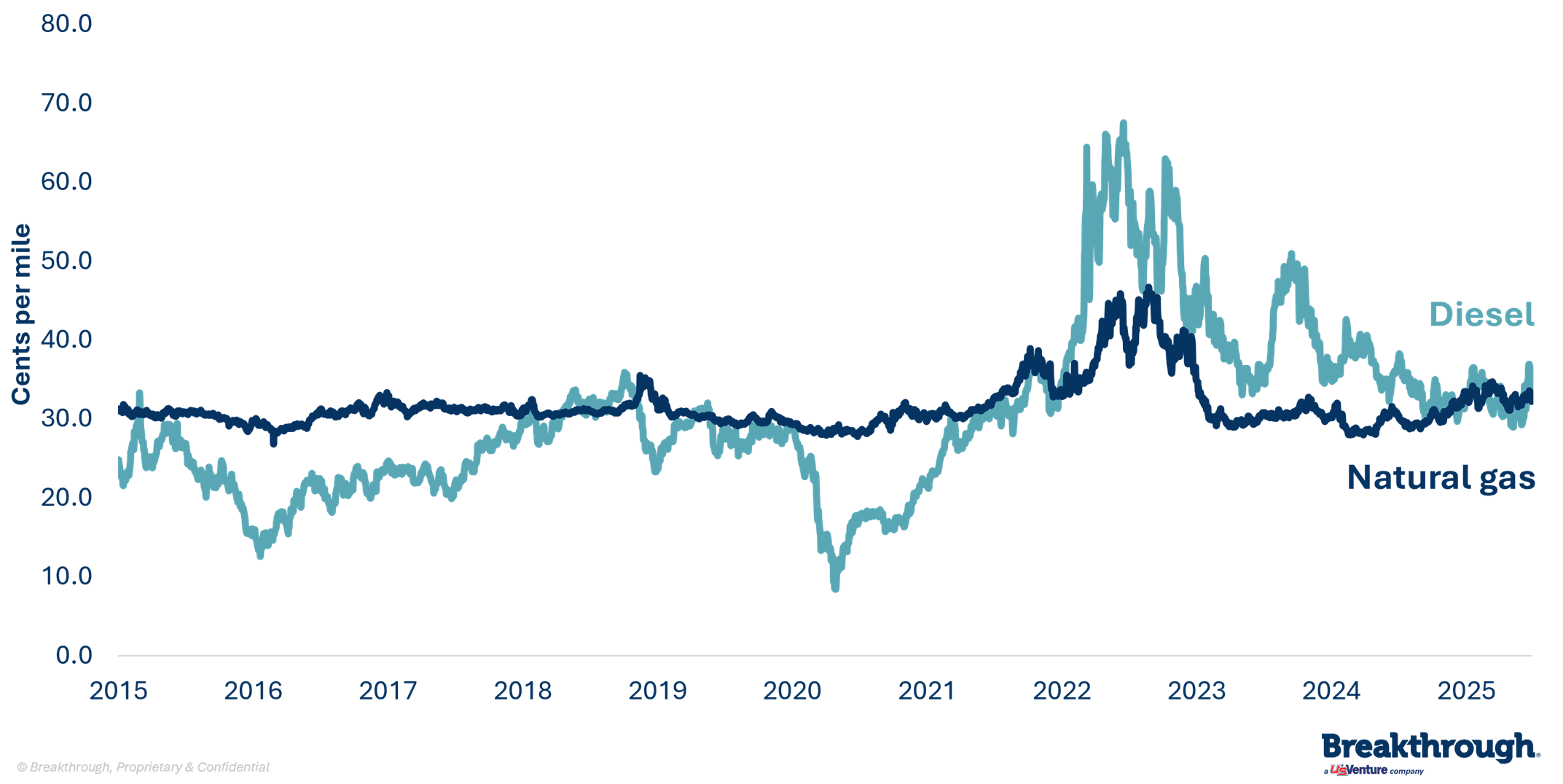
The best strategy for your network depends on your freight. Begin by analyzing your data to identify micro-opportunities that can lead to stackable wins. Key criteria for selecting a solution should:
Provide cost and emissions savings
Integrate with your existing processes
Scale across your network
A solution that is based on real-time, lane-level data will provide the clarity needed to make confident decisions.
Breakthrough empowers shippers with a holistic approach to transportation management. We combine our robust dataset of over $32 billion in annual freight spend, cutting-edge technology, and deep market expertise to deliver actionable strategies. By moving from averages to actuals, our solutions create a powerful synergy between cost control and sustainability.
The future of fuel management is precise, data-driven, and dynamic. Technologies like AI and machine learning will enable more efficient routing, while consumption-based pricing will become the standard. To stay ahead, shippers must embrace a holistic strategy that combines accurate fuel reimbursement, mode optimization, and a thoughtful transition to alternative energies. By focusing on real-time, lane-level data, you can build a resilient transportation network for tomorrow's challenges.
Ready to take control of your transportation fuel costs? Schedule a meeting with us to discuss your fuel strategy.
The most effective strategies target both fuel price and consumption. Implement a market-based fuel reimbursement program where you pay the true cost of fuel, eliminating overspend from average-based surcharges. Simultaneously, focus on reducing consumption through route optimization, minimizing empty miles, improving fuel efficiency, and exploring intermodal and alternative fuel options where feasible. A holistic approach combines these levers, delivering the greatest impact.
Breakthrough’s Fuel Recovery solution replaces average index-based fuel surcharges with market-based reimbursements. It calculates the exact fuel cost for every shipment by accounting for four key elements: the daily price of fuel, the time of the movement, the state-specific fuel tax, and the geography of the lane. This precision eliminates overpayments and provides complete transparency, helping shippers reduce their fuel spend by an average of 20 percent for truckload movements.
Yes, route optimization can deliver significant fuel savings! By using data analytics to determine the most efficient routes, shippers can reduce the total miles their freight travels, which directly lowers fuel consumption. When combined with other strategies like improving fuel efficiency and reducing empty miles, the impact is even greater. It is a foundational component of a comprehensive transportation fuel cost reduction strategy.
A shipper should consider intermodal conversion for freight that is not extremely time-sensitive and travels over long distances (typically 500 miles or more). It is ideal for consistent, high-volume lanes where the cost and emissions savings outweigh the longer transit times. Analyzing your network data can reveal the best lanes for a shift to rail, unlocking substantial cost and sustainability benefits.
Fuel Recovery
Start saving with a real-time, lane-level fuel program.

6 min read
March 27, 2026
Track the Iran War's impact on energy markets. Use our daily update and real-time insights to protect your transportation budget. Read the latest today.
Read more
3 min read
March 26, 2026
Connect with Breakthrough at Gartner Supply Chain Symposium/Xpo 2026. Visit booth #339 and attend our session with Heineken USA to learn cost-cutting strategies.
Read more
9 min read
March 24, 2026
Learn how market-based fuel management strategies improve transportation cost accuracy, strengthen carrier relationships, and support better fuel management.
Read more